
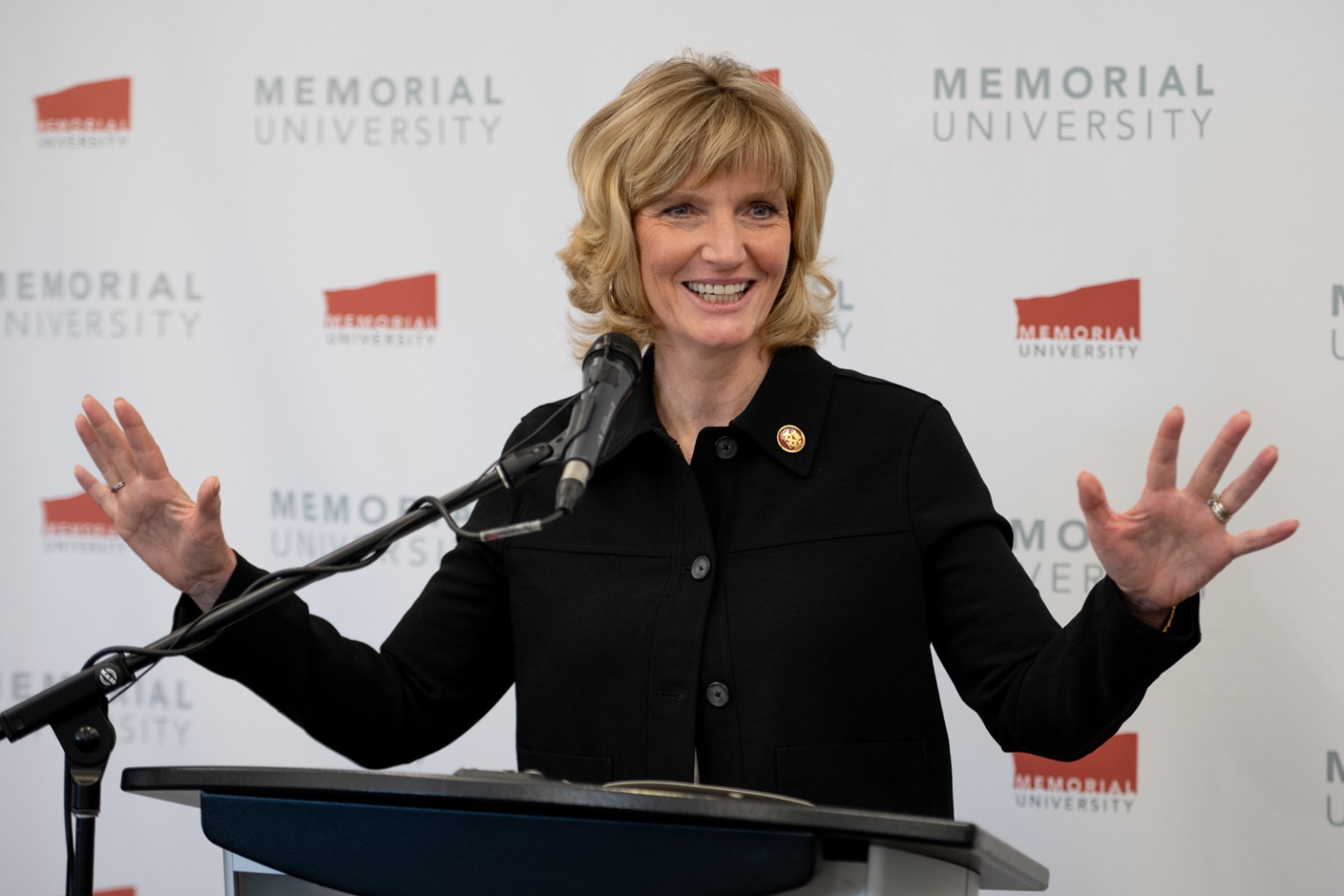
Two distinct images capture two comparable protests, one on December 2, 2021, and the other on May 30, 2024. Both protests targeted Memorial University’s President, yet the responses to these demonstrations were markedly different.
In the first instance, I silently protested tuition hikes and out-of-control spending at the university. I stood off to the side holding a very small sign while since removed President Vianne Timmons gave a speech. As a result of this action, the university administration banned me from campus for three months, persecuted me through the Student Code of Conduct, and gave me a one-year probation sentence. This process was fraught with issues, leaving me with no choice but to take Memorial to court.
In the second instance, MUNSU Executive Director of External Affairs Nicolas Keough protested at a Convocation ceremony. He stood close to President Neil Bose and held up a sign that said, “MUN SUPPORTS ISRAEL’S GENOCIDE IN GAZA.” When Bose finished his speech, Keough shouted in the mic, “Free Palestine!” At the beginning of an Instagram video posted by MUNSU about the protest, Keough said, “Today, I protested Neil Bose at convocation.” The administration then sent Keough and MUNSU expectations, including the prohibition of large signs on stage and no disruptions of the ceremony.
The contrasting disciplinary actions mirror the inconsistency of medieval punishments highlighted by Cesare Beccaria in 1764. During that time, people were often unaware of the acts prohibited by law. Even if they knew an act contravened legal statutes, the penalties were often uncertain. Professor Gomme highlighted the inconsistency of punishments: “Theft of a loaf of bread might result in an agonizing dip in boiling water on one day, the removal of a hand by an axe on the next day, and a warning a week later.”
Memorial General Counsel Scott Worsfold said that my protest “crossed the line” and was “odd.” The complainant, Chief Risk Officer Gregory McDougall, who was not in attendance when my protest occurred, said that the student (me) “position[ed] himself in close proximity to her [Timmons] and “remained close, at a distance of only 3-5 feet from the individual, for the entire time she spoke at the podium.” Furthermore, McDougall stated, “The behaviour of jumping up in front of her was alarming, and together with remaining in close and uncomfortable proximity to her while she spoke, was a form of intimidation and harassment.” McDougall also said that I was “violating personal space.”
At the Supreme Court of Newfoundland and Labrador, Memorial argued that the exemption for silent protest under the Student Code of Conduct does not apply to my action because “the word ‘silent’ is generally understood to mean not conveying information or a message, or doing something without being noticed.” My lawyer Kyle Rees called this reasoning “absurd,” stating, “If what Matt Barter did is not a silent protest, then I can’t imagine what a silent protest is.” I don’t think anyone would argue that a sign with the words “MUN SUPPORTS ISRAEL’S GENOCIDE IN GAZA” does not convey a message.
Memorial also argued that my protest was inappropriate because it was directed at “an individual rather than protesting the decisions of the collective administration.” My lawyer, Kyle Rees, argued that the President of the University is the highest public authority that students can respond to.
Regarding my protest, McDougall argued that he had a responsibility to step in. The students who presented former President Timmons with a pink slip on December 2, 2022, only received a stern warning from McDougall. Interestingly, McDougall was nowhere to be seen for Keough’s protest of Bose during a Convocation ceremony. None of these students were persecuted through the Student Code of Conduct. According to an access-to-information request, I’m the only student McDougall has filed a complaint against since he started the position in 2020.
Throughout Memorial’s investigation of me, they stated that the administration can undertake the Student Code of Conduct process through McDougall. Given that Memorial has the power to file complaints using their chief risk officer, they could have easily initiated complaints for the MUNSU student protests that occurred after my protest.
My protest action was fundamentally tied to a political criticism of Memorial’s administration at the highest levels, especially Former President Vianne Timmons. Throughout my time as a student, I filed over 300 access-to-information requests exposing the extravagant costs of head-hunting firms used for executive searches and lavish office renovations. I also filed the request for executive bonuses at Memorial’s Separately Incorporated Entities, the Genesis Centre and C-Core. Upon Memorial’s refusal to release the information and their denial that they have custody of it, I filed a complaint with The Information and Privacy Commissioner of Newfoundland and Labrador, who released a report stating that Memorial does have the information and that it should be released. Memorial filed for declaratory relief at the Supreme Court that they do not have to comply with the Commissioner’s recommendation. If the court dismisses Memorial’s application, a new precedent will be set that will require Memorial to release records from their Separately Incorporated Entities under the Access to Information Act.
The administration saw my protest as an opportunity to stop my investigative journalism and their complaint against me was calculated and represents a targeted operation by the administration to silence one of their most vocal and effective critics. The administration selectively weaponized the Student Code of Conduct against me — it was a political persecution.
To have a working justice system in any jurisdiction, equal application of the law is critical. A hallmark of unfair justice systems is that some people in society do not get prosecuted, or receive little punishment, while other people do get prosecuted, even for minor violations, and receive disproportionately harsher punishments. The erratic enforcement of rules and disproportionate penalties at Memorial University raises doubts about the fairness of its disciplinary measures.
Matt Barter is a graduate of the Humanities and Social Sciences Faculty at Memorial University of Newfoundland, holding a degree in Political Science with a minor in Sociology. He enjoys reading thought-provoking articles, taking walks in nature, and volunteering in the community.


Leave a Reply