
On September 29, 2026, the Newfoundland and Labrador House of Assembly Public Accounts Committee held a hearing on the Memorial University Facilities Audit Report, with university officials present.
View the transcript below:
Sarah Stoodley: Okay, hello, thank you very much. I’m Sarah Stoodley, MHA for Mount Scio and Chair of the Public Accounts Committee. So, I’d like to welcome everyone to our public hearing respecting the report on Memorial University’s Facilities Management. So, I’m going to do some opening remarks, and then we’re going to do introductions of our committee, the Auditor General’s office, and then introductions of Memorial University’s team. Okay, so… today, for anyone listening live on the website, we have four hearings today. We’re just going to do the first one now, which is Memorial University Facilities Management, and then we’ll have a brief recess before we go to our second hearing for the morning.
And so right now, this morning, we’re reviewing the Auditor General’s report on Memorial University’s Facilities Management. And so our committee wishes to thank the witnesses from Memorial University for appearing today, as well as the Auditor General and officials from the Auditor General’s office. And I don’t know if you’ll mention this later, but the Auditor General was very excited that the president of the university is here, because I understand in the past that the president hasn’t agreed to come. So thank you very much. We really appreciate you being here today. It’s excellent. Thank you very much. I just wanted to extend that. I hope you don’t mind me saying that.
So the Standing Committee on Public Accounts is dedicated to improving public administration in partnership with the Auditor General. The committee examines the administration of government policy, and not the merits of it, and strives to achieve the consensus in its decisions whenever possible. Members take a nonpartisan approach to their work on the committee. And so before we start the review of matters under consideration, we’re going to proceed with introductions of our committee members, followed by the Auditor General and officials from her office, and then the witnesses appearing. And so you do have to wave before you speak, and then your light will come on when you’re on the record.
And there’s no video record today, it’s just an audio record, and there will be a transcript of the House proceedings today. And so that’s me, and now I will pass it over to the MHA for Fogo-Cape Freels.
Jim McKenna: Fogo Island.
Sarah Stoodley: Fogo Island-Cape Freels. Yeah.
Jim McKenna: I’m Jim McKenna, MHA for Fogo Island, Cape Freels.
Sheilagh O’Leary: Sheilagh O’Leary, MHA for St. John’s East, Quidi Vidi. Welcome.
Bernie Davis: Bernie Davis, MHA for the beautiful district of Virginia Waters, Pleasantville, and I’m happy to be here today with my friends from Memorial University.
Joe Power: Joe Power, MHA for Labrador West.
Hal Cormier: Hal Cormier from the beautiful, scenic, gorgeous, mountainous district of St. George’s Humber, where the colours are starting to change right now. So I encourage you guys from Memorial University to come out to Grenfell in another couple of weeks when the valley will be the golden, golden browns and reds. Anyway, welcome.
Denise Hanrahan: Hi, Denise Hanrahan, Auditor General of Newfoundland and Labrador.
Brad Brown: Brad Brown, Assistant Auditor General.
Adam Martin: Adam Martin, Auditor Principal.
Jillian Roberts: Jillian Roberts, Assistant Auditor General.
Adam Lippa: Adam Lippa, Audit Principal.
Lynette Hann: Lynette Hann, Audit Principal.
Jessica Nugent: Jessica Nugent, Assistant Auditor General.
Jillian Hood: Jillian Hood, Communications.
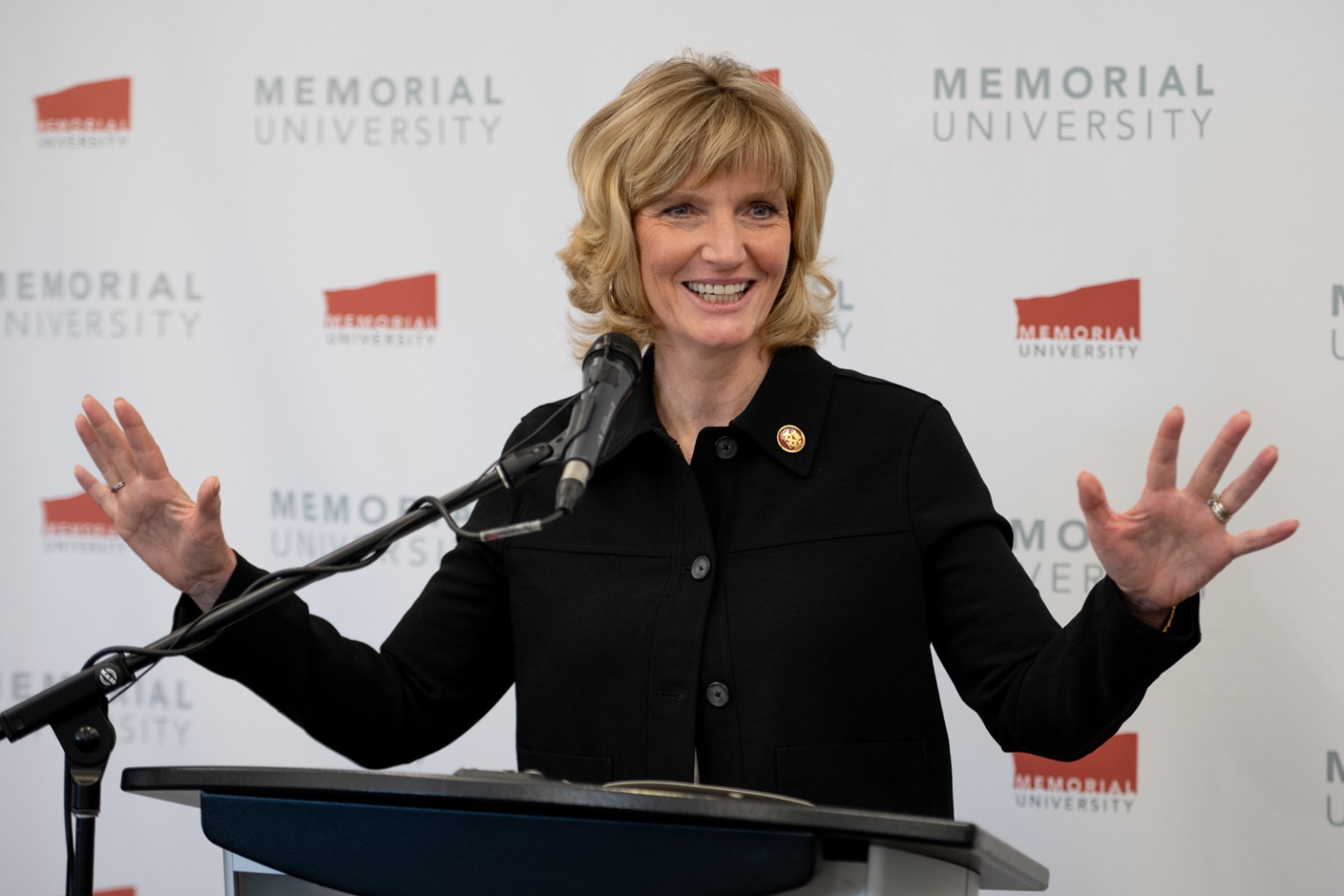
Janet Morrison: Good morning. I’m Janet Morrison. I’m the President and Vice-Chancellor of Memorial University.
Alison Horton: Good morning. I’m Alison Horton, Vice President of Finance and Administration at Memorial.
Rayna Luther: Good morning. I’m Rayna Luther, Associate Vice-President, Facilities with Memorial.
Scott Hill: Scott Hill, Director of Operations and Maintenance with Memorial.
Sarah Stoodley: Okay, thank you very much. So I’ll now outline how the hearing will proceed as well as some reminders for witnesses. And then I’ll call the clerk to swear or affirm witnesses. So firstly… Witnesses are reminded that this is a public meeting and your testimony here today will be part of the public record. Witnesses appearing before a standing committee of the House of Assembly are entitled to the same rights granted to members respecting parliamentary privilege. So witnesses may speak freely, and what you say in this parliamentary proceeding may not be used against you in civil proceedings. And also, live audio will be streamed on the House of Assembly website and social media channels.
And an archived version will be available following the hearing… And so, as I mentioned before, when you’re called upon to speak, you raise your hand, and then the light comes on. And then you identify yourself by saying your name before speaking. It’s a bit clumsy, but you get used to it. Okay, so first, I’ll invite Dr. Morrison, the President and Vice-Chancellor of Memorial University, to make any opening remarks.
Committee Clerk: To the witnesses, please.
Janet Morrison: I, Janet Morrison, do solemnly, sincerely, and truly affirm and declare that the evidence that I shall give on this examination shall be the truth, the whole truth, and nothing but the truth.
Alison Horton: I, Alison Horton, do solemnly, sincerely, and truly affirm and declare that the evidence that I shall give on this examination shall be the truth, the whole truth, and nothing but the truth.
Committee Clerk: Thank you.
Rayna Luther: I, Rayna Luther, do solemnly, sincerely, and truly affirm and declare that the evidence that I shall give on this examination shall be the truth, the whole truth, and nothing but the truth.
Scott Hill: I, Scott Hill, do solemnly, sincerely, and truly affirm and declare that the evidence that I shall give on this examination shall be the truth, the whole truth, and nothing but the truth.
Sarah Stoodley: Okay, well, thank you. So now I call on Dr. Morrison for any opening remarks you’d like to bring.
Janet Morrison: So thank you very much, Chair and members of the committee, for the opportunity to appear before you today. I can’t speak to history, but I’m very clear on my accountability to the citizens of Newfoundland and Labrador, and so appearing today seems appropriate and, in fact, important. I’m equally clear on my accountability across all of Memorial’s campuses, the province in totality. I’m pleased to report that I was in Corner Brook earlier in the semester, and I’ll be back there Monday.
I’m joined today, further to the introductions, by Alison Horton, Vice-President Finance and Administration, Rayna Luther, Associate Vice-President Facilities, and my colleague Scott Hill, Director of Operations and Maintenance in Facilities Management, who are here to assist in answering the committee’s questions. Memorial University takes its responsibility as a steward of taxpayer and tuition revenue and university assets very seriously. Accountability and continuous improvement are essential to maintaining the trust placed in us by students, by employees, by government partners, and by the people of Newfoundland and Labrador as the province’s only university.
Memorial operates a complex physical and digital infrastructure portfolio that supports teaching, learning, research, student life, and community service across multiple campuses and locations. Our facilities range from classrooms, laboratories, residences, and libraries to specialized research and training environments, all supported by critical digital services. Managing a portfolio of this size and complexity requires strong governance, careful planning, and disciplined stewardship.
Managing these assets effectively is essential to fulfilling Memorial’s mission and to delivering value to the people of Newfoundland and Labrador. Memorial belongs to the people of this province. In that context, we welcome scrutiny that helps ensure we are meeting our responsibilities as stewards of the resources entrusted to us. This is the lens of accountability through which we have viewed the work of the Auditor General. Specifically, the OAG has identified areas where we can strengthen our practices, sharpen our focus, and make meaningful improvements across the institution.
The Facilities Management Audit, as you’ll all appreciate, examined the period from January 2022 to March 2024 and was received by the University in early 2025. The report identified opportunities to strengthen governance, oversight, planning, space management, and deferred maintenance practices. Memorial accepted all of the recommendations and committed to specific actions. This morning, we welcome the opportunity to discuss both the progress that has been made and our plan to complete the work that remains outstanding.
The AG identified nine recommendations and 56 associated implementation tasks. In the 18 months since the report was released, more than 80% of these items have been completed or are actively underway. The work that remains is concentrated in a small number of areas where foundational systems and processes must first be established. Chief among these, for example, is the implementation of a modern space management system. Since the audit was released, we’ve taken significant steps to strengthen how Memorial plans for, invests in, and manages its infrastructure portfolio.
We’ve enhanced governance and board oversight. We’ve updated key policies and procedures and advanced a long-term infrastructure renewal plan supported by the province’s investment of $70 million over eight years. Together, these actions are helping build a more accountable, transparent, and sustainable approach to managing Memorial’s facilities and infrastructure. Like many, if not most, universities across Canada, Memorial faces significant deferred maintenance challenges. These challenges have developed over decades and are influenced by the age, the scale, and the complexity of our infrastructure.
While they cannot be immediately resolved, they can be managed through ongoing investment, risk-based prioritization, long-term planning, and strong stewardship. We are committed to following sector best practices to address deferred maintenance across our campuses, responsibly and sustainably. It’s worth noting that all of this work happened and continues to happen in the context of global supply chain disruptions, construction industry shortages of materials and personnel, and increasing costs, challenges not unique to Memorial or to Newfoundland and Labrador.
The Auditor General’s report challenged us to improve specific processes and strengthen how infrastructure is managed across our institution. We have approached that challenge by working to build a culture that places greater emphasis on accountability, oversight, planning, risk management, and stewardship. The reforms we’ve implemented are intended to embed those principles in how decisions are made across the university for the long term. I would now like to invite my colleague, Rayna Luther, to offer brief remarks.
Through her work at both Grenfell campus and the St. John’s campus, Rayna has firsthand experience with the opportunities and challenges of managing facilities across Memorial’s diverse portfolio. Her perspective reflects the realities of infrastructure stewardship in different campus contexts across the province. Rayna?
Rayna Luther: Thank you, President Morrison, and thank you, Chair and members of the committee. As President Morrison noted, my experience at both Grenfell campus and St. John’s campus has given me a broad perspective on the complexity of managing infrastructure across a diverse, multi-campus university. While each campus has its unique needs, the common challenge is ensuring safe, reliable, and sustainable facilities that support teaching, research, a positive student experience, and service to the people of Newfoundland and Labrador. Facilities Management is responsible for approximately 113 buildings and 5.3 million square feet of infrastructure.
Our large, diverse team includes administrators, custodians, campus enforcement officers, skilled trades, project technologists, engineers, accountants, and an architect. Together, this team supports the operation and maintenance of our facilities, the delivery of capital and deferred maintenance projects, sustainability initiatives, protective services, and the financial and administrative functions that support this work. Our responsibilities extend beyond the university. Through a shared services agreement, Memorial provides critical utility services to Newfoundland and Labrador Health Services at the Health Sciences Centre.
This includes regular and emergency power, high-temperature hot water, domestic water, chilled water, and steam for sterilization. Facilities Management in a university environment is inherently complex. We are essentially a city within a city. Projects must be completed in compliance with the Public Procurement Act and increasingly rigorous health and safety requirements. Work often takes place in occupied academic buildings, student spaces, residences, research laboratories containing specialized equipment, and facilities that support critical health care operations.
Our work is also impacted by external factors such as consultant availability, labour shortages in skilled trades, long lead times for materials, and climate change, including the frequency and intensity of weather events. Since receiving this audit in January 2025, Facilities Management has been working diligently to advance core audit recommendations. I am pleased with the progress made and the quality of the fundamental work completed, which has focused on strengthening the systems and processes required to support our core functions. A risk-based deferred maintenance program has been created with oversight from the Board of Regents.
New space management software has been purchased. A new fleet program has been implemented. A draft strategic plan for facilities management has been created, noting this audit as an opportunity for improvement. Key performance indicators have been identified, benchmarked, and measured against. A facilities maintenance plan has been drafted. Governance and oversight mechanisms have also been strengthened through enhanced monitoring, reporting, and accountability processes. These initiatives are helping build a stronger foundation for long-term planning and asset stewardship.
We have made meaningful progress, and we remain committed to the continued implementation of the Auditor General’s recommendations and to the responsible management of Memorial’s facilities and infrastructures. Thank you for the opportunity to discuss the progress made by our team.
Sarah Stoodley: Thank you very much, everyone. So, I’ll now recognize the member for Fogo Island-Cape Freels. We’re going to go, we have 10-minute question blocks, and we’ll go across this way, and then we’ll go to the back here. So, I’ll pass it over to the member.
Jim McKenna: Thank you, Chair. I guess my first question is on facility management strategy. You note that it remains partially implemented. Can you advise what work has been completed to date and if you will reach full implementation by the Auditor General’s fall 2028 deadline?
Janet Morrison: So I’d just say across the board, I’m going to start in response, and then the folks that are actually doing the work are going to provide an added level of detail. So, I think across the areas identified and highlighted by the audit, we’re here today to report measurable progress, clearer accountability, and improved oversight. And our commitment is to implement, as feasible, all of the recommendations. We accepted them, we intend to implement them, and I hope what the committee hears today is not just a commitment to do that, but demonstrable progress.
So I’ll ask Rayna to be specific on that front.
Rayna Luther: Thank you. So as part of the Facilities Management strategy, we’ve done a number of items to move this recommendation forward. We’ve updated the replacement values for our infrastructure that align now with the insurer values. Our preventative maintenance is logged and scheduled in software, and this is based on manufacturer recommendations, regulatory, and code requirements. The guidance related to the timing of infrastructure projects is managed and approved by the Board of Regents. We have plans for maintenance past due and critical, which I’ll speak about when we talk about the deferred maintenance program.
We have a KPI created that measures the maintenance work, and our asset condition changes are recorded in a software program with a detailed log of any changes that have been made by the consultant. We also have a KPI created to measure emergency repairs versus preventative maintenance, so the preventative versus the reactive maintenance. We have created a formal action plan for deferred maintenance, two plans for this for the campus renewal fee that we manage and for the $70 million, the program that we’ve implemented for Facilities Management and for deferred maintenance. And we’ve also drafted a Facilities Maintenance Plan, working with documents that have been created from our colleagues across the country. We’ve adopted that and implemented it into the day-to-day management of our deferred maintenance.
Jim McKenna: Thank you. My next question is space management system. You note that it remains partially implemented. Can you advise what work has been completed to date and if you will reach full implementation by the Auditor General’s Fall 2028 deadline?
Janet Morrison: Again, I’ll just reiterate our commitment to ensure full responsiveness by the deadline. I’ll ask Rayna to provide an update, but I appreciate the way the question is framed because, as with most complex change and particularly technology adoption projects, the work has been incremental, so it’s in progress. Can you just provide us with some details, Rayna, about where we’re at and what we’ve done, and what remains outstanding?
Rayna Luther: Sure. So the Board of Regents did approve funding for the purchase of space management software. We have purchased that software, and we are working with the supplier now to install that software. And once we install it, we’ll be able to continue building upon that and work on those recommendations that President Morrison referred to that need this fundamental step in order to proceed with those.
Jim McKenna: Thank you. My next question is on space information accuracy. You note that you have taken no action. Can you advise if any work has been completed to date and that you will reach full implementation by the Auditor General’s Fall 2028 deadline?
Janet Morrison: Again, we anticipate further corrective action prior to the deadline. There certainly has been work done in this particular area, and I would note and perhaps call on Vice-President Horton to speak about the work that has been done, particularly in the context of our new budget modelling. So, Alison, can you just provide some detail on what’s been done?
Alison Horton: Yeah, so as the audit referenced, the opportunity for transparent information to guide decision-making is something that we take very seriously, and that is reflected in the new budget model that we are actively developing right now. We are about a year into planning and about to start implementation. The focus of that budget model is on improving transparency, oversight, and accountability, and it shifts from a focus on incremental budgeting or historical allocations to connecting how we budget to activities and costs and, again, accountability.
So it allows us to understand the full cost of operations, which is important given that facilities and infrastructure are a critical cost driver, but also… a key resource and an asset that we have at the university.
Jim McKenna: Thank you. That’s all for my questions right now.
Sheilagh O’Leary: Welcome again. Sheilagh O’Leary, MHA for St. John’s East-Quidi Vidi. Pleasure to have you here to answer some of the questions. So I’m just going to begin with a few things here. I guess in a general sense, does Memorial now have a clear picture of its condition index? Does it have a clear picture, understanding that there’s a lot of technology that’s being used now to catch up with a new president, a new Board of Regents? Is there a clear picture now, as was outlined with the Auditor General’s report? I’m just wondering if you’d give me some more specifics, I guess.
Janet Morrison: I can say with confidence that we have a better picture of our circumstances broadly. I can speak specifically to my 14 months of experience. This has been an ongoing process to understand Memorial’s circumstances and to contemplate the path forward. The university… like every university I’m familiar with in the country, is navigating tremendous disruption and uncertainty at the moment. Much of that is being driven by enrolment, and the enrolment conundrum facing Canadian colleges and universities is a function primarily of three things. The first is the demographic profile of the country, particularly in the burgeoning 18 to 24-year-old category. It is a function of just tremendously increased competition in the higher education space. And the third piece of that puzzle is dramatic and perhaps poorly communicated changes to immigration policy. Enrolment fundamentally drives everything about a university, its size, its scale, its financial circumstance.
And so the disruption in that space is critically important to our current state and to our future. And that obviously impacts infrastructure. Memorial has a tremendous investment in capital and physical infrastructure, digital infrastructure as well. But understanding our enrolment trajectory, I’m sure nobody is naive to our public statements that enrolment is down 2,000 students since 2021. In the absence of intervention, which of course we are deeply vested in, but in the absence of intervention, the forecasting alone would suggest we’re going to be down another 12% by 2030.
And so everything we do is impacted by that reality. It’s why enrolment and enrolment recovery is amongst our top priorities. So I’m confident we have a much better handle on our current circumstances. I would not want to suggest, with due respect, that they’re any less complex. Thank you.
Sheilagh O’Leary: Thank you. That was a nice overarching kind of perspective to have. So, I have a couple of questions here. Of course, you know, understanding human resources is also one of education’s strongest assets. And, of course, recently the university has eliminated, either laid off or through attrition, 105 jobs recently. So we’re just wondering if that money… being planned to use for deferred maintenance. Is that going to be a part of this equation?
Janet Morrison: So broadly, and again, I assume people are quite conversant with the communications that we’ve issued in this space, and certainly I hope people recognize the transparency and the timeliness of the communications we’ve been committed to over the course of the last 14 months. But that contraction was in fact tied to our commitments on operating budget for the 2026-2027 fiscal year. So, I will ask Rayna, who can defer to Alison if she’d like, to talk about how we are now budgeting for deferred maintenance.
I think, important to note, we have specific and dedicated funding on deferred maintenance that is supplemented by operational dollars, which I think was rightly observed as a gap a couple of years ago. But I want to be very clear that those contractions in FTE on the employee side, first off, were done with all intention to minimize the impact on colleagues, but also to meet our budget obligations in the context of the university contracting. Again, our revenue is tied to enrolment, so those would be on the operating side.
Rayna, do you want to speak to deferred maintenance and funding broadly?
Rayna Luther: Sure. So deferred maintenance at Memorial is funded through two main streams, one being the campus renewal fee, which has been supplemented by the provincial government budget. That equates to about $7.8 million a year that we… put towards deferred maintenance, and the second funding stream is the $70 million eight-year plan that was announced in the previous government budget, and that equates to about $8.8 million over that eight-year period. So together, those combined, we use to budget for and allocate projects to our deferred maintenance.
Sheilagh O’Leary: Okay, thank you. And again, talking about demographics, of course, we know that enrolment is a challenge. And of course, Newfoundland and Labrador has an aging population and significant labour shortages in professions trained at Memorial. So, have you asked the government for increased funding to support the university’s upkeep so these job cuts are not necessarily the answer?
Janet Morrison: So first off, I want to distinguish between, again, the contraction exercise and our deferred maintenance. I certainly appreciate at the end of the day that it’s all a consequence of funding, but for me those are two equally challenging but distinct realities. We remain in very close conversation with the government about our current reality, about our current enrolment state, but also our forecasted challenges. We’re also in conversation with the government about labour market demand, particularly in the context of Newfoundland and Labrador’s planned major infrastructure projects.
Those conversations are ongoing, and with direct… relevance, I think, to the conversation we’re having this morning, I’m sure you can all appreciate that there are space implications for that. We need very different space to educate engineers or professionals in marine industries than we do to educate, for example, the incredible graduates from music or from folklore or from English. All of those learners. equally valued, and we expect to contribute equally economically, culturally, and socially to the province, but the space demands are very different.
So as the enrolment trajectory shifts, both in numbers and in areas of programmatic interest, we have some challenges on the facility side where foresight, accountability, process, and policy will be necessary.
Sheilagh O’Leary: Well, and thank you. And certainly as an older, mature student returning to university and getting a master’s only in recent years, you know, it’s an interesting equation to see in the fine arts realm on Grenfell Campus. So I’ll just switch gears a little bit here with the limited amount of time I have left here now. There was a good reference, obviously, to climate change, which I was very pleased to hear about. And just wondering if, obviously… a climate action plan is an absolute these days in regard to infrastructure and the impacts.
I know certainly from my former municipal role and certainly here as an advocate in pushing our government to create a solid climate action plan. What do you have in store for a climate action plan so that we can ensure that we have this infrastructure protected going forward for the university? Thank you.
Janet Morrison: So thank you. I’m going to pass that to Rayna. I will say, as someone from away, I never go anywhere where we don’t talk about the weather here. So I’m somewhat comforted that it came up this morning. So I’ll ask Rayna to comment. But clearly, in the context of infrastructure, we have challenges around the elements. And as is being experienced all across the country, around the globe, those challenges are becoming more apparent and more significant every day.
Rayna, do you want to comment on that?
Rayna Luther: Sure. So we’re actually working with our colleagues in the provincial government and Newfoundland Power, just to name a few, in terms of the climate change and our responsibilities to adapting to these changes. The challenges we’re experiencing aren’t unique to Memorial, so we learn and share with our colleagues to build upon that. I actually spoke recently at an asset management conference where we spoke about the challenges of climate change and how it’s impacting the way we do business. And our consultants obviously stay very up to date on… code changes and things that we need to design for. It’s not simply just replacing like for like anymore when something fails. We have to incorporate the resilience and changes needed going forward as we plan and repair to make sure that we can sustain the frequent and intense storms that we’ve been seeing.
Bernie Davis: Thank you all for coming. It’s always nice to see the president come to these things and show the value that the PAC committee has with each department and agency that we do have. I may not get to all my questions now, but in the second round, I probably will. A couple of them are quick, and if you don’t have them, that’s fine. Just let me know, and we’ll see if we can get that information. How much leasing space do you currently have?
Rayna Luther: So, we have approximately 19 leases in place currently. That’s a combination of space and land that we lease in various locations. And actual space, it sits around 75,000 square feet at the moment. And that doesn’t include accommodations across the province that fluctuate for medical student accommodations.
Bernie Davis: Thank you. It’s amazing when you hear earlier in your remarks 113 buildings, I think you said 1.3 million square feet of space. That’s amazing. So based on that information, it sort of slanted my question a little bit. If we’ve got that much space, have we done a good look at that now? Because I know in the report there was vacant space that could have been used. I guess there were different silos that were existing that allowed leasing to happen when space at Memorial could have been utilized and done. Is that something that’s being considered now on a go-forward basis?
Janet Morrison: Yeah, thank you for that question. So, you know, we are not entering into new leases, save for the medical space, where I assume, please ask if there isn’t clarity about that, but our commitment to ensure that we have med students available all across the campus, I’ll parcel that out for folks. I will say the level of scrutiny around leases has increased significantly. Happy to speak specifically about what that looks like, but… the Board of Regents actively involved in those reviews and contemplation, ultimately at the governance level.
We have, again, some challenges in the context of declining enrolment and an existing footprint that has not grown since, but that has to be, I think, continually re-evaluated and assessed. I think there are… opportunities based on experiences elsewhere to use space in new and different ways. But I don’t think any of us would for a second suggest that all of our space is being optimized at this moment.
Again, down 2,000 students since 2021 on the back end of COVID and changes in learner behaviour, particularly around the desire and demand for hybrid and online learning, we have to be responsive to that. And so first and foremost in that exercise is a heightened level of accountability and oversight, and we hope you’re seeing demonstrated progress on those fronts. Memorial is investing in a strategic planning exercise, and central to those conversations must be our footprint, our obligations as a community anchor and a contributor. And I think space can play a big role in that conversation.
Bernie Davis: Thank you, Dr. Morrison. You mentioned utilization then, and that sort of leads into another question that I had based on labs and classrooms. I noticed in the AG’s report that there seemed to be low utilization of those, and it was a bit surprising to me considering that wasn’t… known to the public until this result. Was that known to the university at the time? And is that one of the consequences of the silos that each department was creating?
Janet Morrison: So I can’t speak to what people knew or didn’t know at the time of the audit. I think we certainly acknowledge that as a consequence of the audit, we are obligated to respond in that space. What you’re hearing today, I hope, is a pan-university, one Memorial approach to oversight policies, procedures, and governance. Very clear that… facilities management and other functions span Memorial, all of its campuses, and all of its activities.
So that is a renewed commitment to, again, a pan-university approach on all of those fronts. On academic space utilization in particular, I’ll ask Rayna to comment. But again, this is not unrelated to Memorial’s enrolment challenges, both a decrease in the number of students, but also changing patterns in enrolment, requiring different types of space, and in some instances, very specialized space, particularly at the graduate level in a building, for example, like Core Sciences, which was built for specialized teaching, specialized research.
So, Rayna, can I ask you to just give some details on the academic space?
Rayna Luther: Sure. So as I referenced earlier, this is part of that fundamental work that we’re doing to be able to build on the recommendations in the audit. And a main step that the Registrar’s Office at Memorial has taken is to ensure the quality of that data. And they’ve done great work in increasing the amount of academic units that are actually using Infosilem, which is the software to be able to track the utilization. They also are working on academic scheduling guidelines, which they’re aiming for next fall to be able to implement those, and that is also going to work on assigning classrooms to specific spaces and slots which will impact the utilization.
It’s also really important to understand that Memorial has… classroom spaces, which are fairly generic, but also very specialized teaching and learning spaces. So the utilization can’t be compared across the board. There’s some areas where 100% utilization just wouldn’t be realistic just in the nature of those labs. So we have to benchmark those accordingly to be able to measure against those in the future.
Bernie Davis: Thank you, Ms. Luther. I don’t think anyone on this side would think that 100% would be where you need to get to. I think there’s got to be some benchmarks across the country. I think the Auditor General’s looked into those, and it seemed to be somewhere around 60%, 70% maybe will get there. And I know we’re going to try to get there, and this is not all negative today. This is just more so delving in to see what progress has been made. One of the things, and sitting on this side of the house years ago, when the new Core Science Building was built as a replacement for the old Science Building, and that never seemed to fruition because I still see the old Science Building there being utilized. Do you want to speak to that for a quick second just to see what the next plans are for this?
Janet Morrison: Yes. So the Core Science Building was built for specific teaching and research purposes. You know, at the time, this was the building that was determined to be necessary and responsive to enrolment, student and research priorities. I would say much has changed since that planning was undertaken. And again, I know I keep coming back to this, but enrolment patterns in particular have changed dramatically since the original planning for that business or for that building.
It was never the intention to entirely substitute what was happening in the, I’ll say, old Science Building. But, like many other projects at Memorial, part of the challenge in relocating some of the outstanding occupants of that building is cost and the suitability of space. So, Rayna, do you have some specifics? Is there anything else to add on that front?
Rayna Luther: So, some units did move out of the Science Building into the Core Science Facility when it opened. There are several units that are still operating in the Science Building today. There is a plan, some fully designed to move those occupants, such as Geography, Humanities, Social Sciences, Psychology, but they are still operating out of that building until funding is available to be able to implement that plan and move those occupants out of that building. If we’re successful in moving the occupants, the demolition of the Science Building would proceed then.
Bernie Davis: Thank you. I’ll squeeze a quick one in. Sorry to my colleagues for that. You mentioned a plan for deferred maintenance and liability. I just want to, as of today or recent time, what is the liability, deferred maintenance liability, and has the university achieved any reductions since the audit has been put in place? I think there’s some positive stuff to be talked about here, so I think it’s important for the public to hear.
Janet Morrison: Thank you very much. I’d start with two pieces. Rayna or Alison, Scott can chime in. So the first piece of the puzzle is the heightened level of governance, accountability, and oversight on deferred maintenance. So you heard my colleague Rayna talk about enhanced processes on deferred maintenance. So, dedicated funding sources, again from the campus renewal fee, but also from government. So, renewed investment and a long-term plan for addressing the deferred maintenance backlog.
I will say long-term planning is challenging in an environment where Memorial lives year to year. We don’t have long-term funding commitments. We live fiscal to fiscal, with uncertainty in that space. And so we continue to talk to the government about the consequences of that, particularly when funding… I was very pleased with the outcome of this. We can always use more, but when funding is announced into the fiscal, there are planning challenges associated with that approach.
So I think on the funding side, more accountable, heightened oversight. But I’ll also draw members’ attention to some of the very difficult decisions that Memorial has made over the course of the last year around the divestment of real estate deemed not to be closely aligned with the university’s academic mission. And so those were very, very difficult decisions. But the decision, again, to divest of property specifically, and all of these instances are different and being managed differently and carefully, but the decision to divest of the Harlow Campus, of the Signal Hill Campus, of the Geo Centre, and of the Ingstad building, all of those, over time with that divestment actioned will decrease the university’s current and then more importantly long-term deferred maintenance liability.
Is there anything else to add, colleagues?
Rayna Luther: So we do measure, and a common term that you’ll hear is the facility condition index, and that’s a ratio of the deferred maintenance that’s outstanding versus the total replacement of the buildings. So, Memorial… has reduced the facility condition index from the audit period to now. And that’s a combination of the work that we’re doing and the asset replacement values being adjusted. So we’re currently at around 25%. And there’s a lot I could say about deferred maintenance as spoken. Our oversight processes have changed significantly since the audit. And we have excellent… data to show all assets and the conditions of all assets in all of our facilities, and that’s all documented.
Joe Power: Joe Power, MHA for Labrador West. Welcome. You said earlier that enrolment was down by 2,000 students. It seems like a lot, and you said you had a recovery plan. I was just wondering if you could give the general public some reasons why enrolment is down and what your recovery plan looks like.
Janet Morrison: Thank you for that question. I’m happy to talk about enrolment because I actually think it’s not just one of Memorial’s top priorities. I think it has to be one of the province’s top priorities. I very much view Memorial as a magnet for talent, for economic, cultural, social growth, development, and renewal in the province. I think Memorial has for 100 years served as an important magnet for that talent, but also as a delivery agent for the next generation of leaders in this province, again, across all industries and community partnerships.
The challenges on enrolment, again, are not unique to Memorial. I want to be very clear about that because I’m not sure that that conversation has been public enough. But I think we’re feeling some impacts more acutely. So the first piece of that puzzle, frankly, is the demographic profile of the province. And I don’t need to tell representatives about the challenges that that poses. Memorial, very pleased to report an increase in first-year enrolment this fall and next fall. I’m going to distinguish very carefully between first-year enrolment and total enrolment.
Total enrolment is still down, but first-year enrolment is up nominally. This is a consequence of a bump that is, we understand, largely driven by new Canadians and their children graduating from grade 12. And as I think everybody in Newfoundland and Labrador would expect, Memorial has worked very hard to capitalize on that and to register as many of those students as possible because we know when students study at Memorial, they stay in Newfoundland and Labrador. So we saw a positive bump in new student enrolment this fall.
We’re anticipating, hoping for a similar bump next year, but total enrolment continues to decline, and that’s a consequence of five years of progressively fewer students choosing Memorial. So that’s the first piece of it, demographics. The second piece of it is unprecedented. I’ve been working in the post-secondary space for 40 years. Never has competition between domestic universities been higher. And that’s a consequence of every province and territory wanting to keep their own talent.
And we have to compete more successfully in that space. And so we’re working to understand what the value proposition is for learners. That is about cost, which we compete very successfully on. But it’s also a commentary on the value proposition post-graduation. Where is their income security? Where is their job security? The third piece of that puzzle is the… the changing immigration environment. I met with the Federal Minister for Citizenship, Immigration and Refugees yesterday, again, to talk about the unique circumstances, not just of the Atlantic region, but frankly of Newfoundland and Labrador.
And I would ask every representative from our province to continue the advocacy for a carve-out for Atlantic Canada and specifically for Newfoundland and Labrador. If I forecast six, seven years down the way, Memorial can deliver the social, cultural, and economic talent that this province needs, but we need to plan for that now. And the absence of foresight, I fear, is going to be significantly detrimental to the commitments that we’ve made and the energy and enthusiasm across the province that some of those projects have generated.
Joe Power: Thank you. Next question. Are there any critical maintenance projects existing today that are being delayed beyond recommended timelines, and how do you decide what to defer versus what to proceed with?
Janet Morrison: So good questions. Two questions there. The first is, are there, I might not use the word critical, I would maybe use urgent. Projects that are being delayed or on hold? The answer to that is yes, and I’ll ask my colleague Rayna to give some examples. Your second question is about how we decide what to do first, and I’ll ask Rayna to just elaborate on our risk-based approach, which was, I think, absent previously and has now become fundamental to our culture and our practice. Rayna?
Rayna Luther: So, one of the key changes that we made in the new process for managing deferred maintenance going forward was that risk-based approach that the president just referred to. So, we have strict criteria for projects to meet that first criteria level to be considered under the program. If they meet that initial intake, we have a working group that assesses based on risk. So, we prioritize the risk. We evaluate each project. And we prioritize based on the severity and the impact that that project could have. So, instead of looking at priority on a timeline, some things could be past due based on when they should be replaced.
But we’ve switched that thinking to look at a risk-based approach. So we’re prioritizing projects that have the potential for the largest impact to the university community if they were to fail. And that’s a big change that we’ve seen in our new approach going forward.
Joe Power: Do you believe you have reliable information and data to make informed management decisions, given the audit highlighted the unreliability of information?
Janet Morrison: So the question is, do we believe we have reliable information to make good, informed, safe, accountable decisions? I believe we are in a far better spot than we were 18 months ago, and I appreciate the value of the Auditor General’s findings to spur the continuous improvement that I hope you’re seeing evidence of today.
Joe Power: Thank you. Are you leasing any spaces outside of MUN’s footprint and how much space are you renting outside MUN’s facilities?
Janet Morrison: So, I can ask Rayna to reiterate our commitments on number and square footage of leases, but I will just note again, yes, we do lease property off of MUN’s campuses, and the example I would note for folks relates to medical education, particularly in rural remote northern communities where our commitment is to ensure access to medical learners in those spaces. Rayna, did you just want to reiterate the numbers on leases, please.
Rayna Luther: So, we do lease space and land in off-campus locations. We have about 19 of those leases right now, and the total building space is about 70, in the vicinity of 70, 75,000.
Joe Power: Thank you. Is the current Science Building being fully utilized for academic purposes and services to students?
Janet Morrison: The short answer is no. As Rayna has referenced, there are a number of units and departments that have moved out of that building into the new science centre or into the new Core Science Building. There are a number of moves that are pending funding to move colleagues and programs. Rayna, do you want to speak specifically about where we’re at relative to, you know… All of this is a function of resource. The moves are a function of resource. The planned demolition of the building is a function of resources.
You want to talk about where we’re at, Rayna, and what the medium plan is?
Rayna Luther: So the Science Building is approximately 60% occupied at the moment, and it is occupied by units that… We have a plan to move them. In some cases, we have areas designed, and we’re ready to go to tender on some of those areas, but it’s pending funding. So the main focus would be the geography department, psychology department, and humanities and social sciences. We would need to move them to… dedicated space, and then once that building is vacated, we would then proceed to demolish. The plan would be three wings of the four because we would have to maintain some critical services that are in that remaining wing.
Joe Power: Thank you. That’s it for me now. I’ll pass the floor to my colleague here.
Hal Cormier: Hal Cormier, St. George’s Humber. Good morning. I apologize in advance if some of these questions may seem repetitive, as a lot of the answers given this morning so far have answered other questions, so I apologize in advance if I seem repetitive. Have you reviewed what the campus renewal fee has been used for since the audit? Has the university informed students on that spending?
Janet Morrison: Thank you very much, because I don’t actually think we have focused on that piece of the puzzle. And so, again, this is an area where I think you’ll observe a heightened level of accountability and reporting. And I think this is a great example of our demonstrated commitment to transparency and communication. So excellent, I think, updates in terms of process, but also in terms of our… the transparency with which people know how we are expending public resources. Rayna, we want to give specifics on the approvals process and how information is now publicly available.
Rayna Luther: Sure. So an overview of the oversight that’s now in place for deferred maintenance at Memorial. I’ll give a little bit of a timeline. So, December 2024, the Board of Regents approved a new process and the risk-based evaluation criteria that I referred to earlier. In January 2025, a new oversight committee was established with co-chairs being myself and the chief information officer. Terms of reference created for that and agendas and meeting minutes for each of those meetings. In March 2025, the Board of Regents approved the 2025-26 campus renewal fee, physical and digital project allocation, which was about $7.8 million, and that was recommended based on the risk-based approach that was used to create that list.
In December 2025, the Board of Regents approved the 70 million eight-year deferred maintenance program that was presented to them, and that was based upon, developed using eight guiding principles for the university. Updates for that program are provided at each Board of Regents meeting through a capital projects report. In February 2026, the Board of Regents approved the 2026-2027 campus renewal fee physical, digital project allocation. So, another $7.8 million dedicated to deferred maintenance. In June of this year, a status report on the projects funded in the 25-26 fiscal year was reported to the Board of Regents to update them on the status of the work that was completed.
And both the 2025-26 and the 26-27 campus renewal fee programs are listed on Memorial’s website in full transparency so that students, members of the public, anyone that wants to look can see what’s been approved under both of those programs.
Hal Cormier: Thank you. And answering those questions, you’ve answered some more for me, so thank you very much for that. I’ll cut right to the chase. Will the university reimburse the fund for expenditures that could be considered inconsistent with its intended purpose?
Janet Morrison: Is the question specifically around the campus renewal fund?
Hal Cormier: Yes.
Janet Morrison: So I would just offer the Pan University Campus Renewal Committee that was established very clear on the specific purpose of those funds with enhanced… policies, processes, and criteria. So, you know, I am confident that the renewed approach aligns with the fund’s intended purpose and would just further suggest that the transparency with which funded projects are communicated, both internally and then publicly, is yet another mechanism for accountability in that space.
Hal Cormier: Thank you. Switching gears. In the audit report, it was noted there was a $481 million backlog of deferred maintenance. Coming from an industry that done a lot of deferred maintenance that put employees, staff, visitors at risk, what is the current deferred maintenance liability with Memorial now?
Janet Morrison: Thank you. So I’ll ask Rayna to go back over the numbers, just a couple of points. The first is that we have transitioned to a risk-based approach because consistent with your comments, obviously the health, the well-being, the safety of our communities, including our internal community visitors, users of our campus, of utmost concern and priority. So the risk-based approach off the top. And then the mitigation strategies on deferred maintenance, both the work that has been done that is scheduled with longer-term planning underway, and then to the numbers, which I’ll get my colleague to speak to, the initiatives over the last year that have served to bring both the index but also the deferred maintenance liability down.
Rayna, do you want to go over those numbers again for members?
Rayna Luther: Sure. So Memorial currently sits at approximately 25% for the facility condition index with a deferred maintenance liability of approximately $570 million. And I will just speak for a moment about work CAUBO, if people are familiar with that, the Canadian Association for University Business Officers, they’ve done a lot of work in the deferred maintenance area. They’ve issued a number of reports over the years, the last being 2019, where they stated the values of deferred maintenance across Canadian universities.
So deferred maintenance isn’t unique to Memorial. Our colleagues across the country also experience challenges associated with that. And that association is currently working on updating the numbers and being able to have a centralized approach for the universities across Canada. And I’m sitting on that committee.
Hal Cormier: Thank you. I’ll finish up. Before requesting additional provincial funding, what evidence can Memorial provide that has addressed the deficiencies in planning, oversight, and maintenance prioritization?
Janet Morrison: I hope we have effectively communicated. Governance and oversight are demonstrably stronger today. Happy to have Ms. Luther review some of the tactical changes, again, in policy, in practice, in measurement. There are concrete, verifiable, corrective actions that have either been taken or are committed to over the… outstanding balance of the audit period and I hope perhaps most fundamentally.
What the committee is hearing today is a commitment from Memorial’s leadership to continue building a culture of accountability and transparency across all of our operations, noting the fundamental importance of facilities. Would you like us to list some of those examples? Again, we’d be happy to do that. We’re very proud of the work that’s happened, so we’d be happy to do that if that’s a good use of time.
Hal Cormier: I would love to hear a few examples, sure. I like what I’m hearing here this morning. I like how Memorial has come in with an open mind and a progress on what the audit has produced. So I’d like to hear a couple of examples and we can move forward from there.
Rayna Luther: Sure. So deferred maintenance work sometimes ranges from very specific replacements, for example, of air handling units. It can also be represented in larger projects that… do a number of deferred maintenance projects all in one. So an example of some of this, we demolished Coughlan College this year. And by demolishing Coughlan College, we reduced approximately $8.4 million of deferred maintenance liability that the university carried with that facility. So that’s an example of a larger project that… had a big impact on our deferred maintenance. We waterproofed approximately 500 metres of tunnels across the university.
We’ve completed structural repairs to utility tunnels that carry very critical infrastructure for both Memorial and the Health Sciences Complex. We’ve started the construction of a new data centre. We’ve completed conditioned assessments on all elevators on campus to help us prioritize that work going forward as it relates to the $70 million deferred maintenance program over the next eight years. We’ve completed arc flash studies, which is deferred maintenance as well as has big safety impacts, and we’ve completed corrective work on that arc flash initiative in the main data centre at the university.
We’ve also done a number of roof replacements and repairs across the university, as well as heat pump replacements, air handling units, and as mentioned, in full transparency, we’ve listed the deferred maintenance program components on our website.
Hal Cormier: My time’s expired.
Sarah Stoodley: Thank you very much. I’ll also mention, I didn’t mention this earlier, there’s bathrooms in the hallway behind you if anyone needs to. We do have another hearing this morning before lunch, so after I speak we’ll go around and see if anyone else has any other questions. So the most burning one for me is I’ve been involved with Memorial in various capacities since being an undergraduate student. And there’s always a tension between academic freedom or how it’s put to a non-academic person like myself. And I know a school or department or a faculty member will get research money and they can spend it as they wish.
And that causes a lot of, I guess, IT technical debt or maybe infrastructure technical debt. That might not be the right term. Wondering how it seems to have been, and I was an elected member on the Board of Regents, and it seems to have a significant negative impact on the ability to efficiently and effectively manage the resources of the university, maybe rightfully or wrongfully. Just wondering if… If I can get your thoughts on that in terms of this audit report and can the needle be moved and should it be moved? And I just welcome any comments you have on that tension because that’s, I guess, the top thing that comes to mind when I reflect on this Auditor General report. Thank you.
Janet Morrison: Thank you for that. So that’s the beauty of a university campus, both in… in terms of benefit and challenge. So, I will defend academic freedom at every opportunity. Board of Regents would too. I really appreciate your active involvement over the years. Academic freedom is a tenet of what we do. It’s the foundation of the teaching, learning, research, discovery, and service that the university does all across this province, nationally, globally.
But I think in the context, again, of broader challenges, the example I will use is cybersecurity. I would say 40 years in the sector, there is a shared understanding of the imperative to be pan-institutional, particularly in the context of risk. And I think we have found a very positive, collaborative space to work collegially on campus on issues of shared concern, whether that’s cybersecurity or the safety, well-being, and maintenance of facilities.
I talk all the time, consensus on a university campus is an illusion. You are never going to put… three plus thousand people whose job it is to cultivate critical thinking in classrooms, in research labs, they are never going to agree on anything. But what you do get is good ideas and informed… conversation. And where we have found resonance in shared purpose is around issues of risk. And again, facilities management, both digital and physical infrastructure is a good example where we respect academic freedom, but also articulate and then pursue interests of shared concern to the university and its stakeholders.
I hope what you’ve heard today is a pan-university approach to managing our facilities. We take a similar approach across digital and physical infrastructure. And I would argue we’re moving in that direction on enrolment because I think we all appreciate that the university’s future depends on it.
Sarah Stoodley: Thank you very much. Some specific questions. You mentioned the divestiture of real estate. I’m wondering if you could walk us through what the next steps are for those, because I don’t think they’ve been on the market yet. So I’m wondering when that will happen and what the steps are to get there.
Janet Morrison: Yeah, I’ll ask Vice-President Horton to comment on that.
Alison Horton: Thanks for the question. So, as members would know, the announcement in January 2026 to divest of the properties that were listed previously occurred. And as we mentioned before as well, our expectation is that… This will provide about $3 million in reduced annual operating costs, as well as approximately $20 million in future deferred maintenance liabilities. We are actively working on all fronts on this project. That’s including appraisals which have been completed, market readiness activities.
There’s a wide variety of that. Transition planning as well, as you can appreciate. We have various teams and departments and partners that are at these various locations, also transitioning students who are living in residence at Signal Hill Campus to our main campus and other housing opportunities, working very closely with them and then decommissioning planning as well that is underway. What we are waiting for is LGIC approval so that we can initiate that next phase, and we’re ready to move as soon as that happens.
Sarah Stoodley: Thank you. So, I know LGIC approval is required to buy buildings, so I’m assuming that it’s the same for selling buildings? Thank you. So, President Morrison, during, I believe, your response to the first question, you mentioned that your commitment is to implement the Auditor General’s recommendations as feasible. So, wondering if there are any areas where you’ve identified which are not feasible or you believe that may be more challenging to implement.
Janet Morrison: Thank you. So the example I would just come back to is our enrolment, our current enrolment state and our enrolment trajectory. So notwithstanding, I think the audit did a great job of identifying areas of focus and opportunity. Without being explicit or directive about targets, but in some spaces, for example, the changing nature of our enrolment, where we are seeing shifting patterns in student interest in some programs versus others, there may be a longer-term planning process necessary to try and transition to the types of spaces that will be required to support learners in specific disciplines. And so the messaging and the direction, I think, about… measuring what we do, being more accountable, enhanced oversight, understood, and being actively embraced. Some of the specifics around, for example, academic space usage, are subject to a number of variables that are very challenging for us right now. I hope that helps.
Sarah Stoodley: Thank you very much. I’m wondering if there’s any areas in the Auditor General’s report that you would, I guess, disagree with or want to add reflections on or any other commentary that comes to mind.
Janet Morrison: That’s a good question. You know, I wasn’t here at the time. And so certainly the observations, I think, spurred tremendous conversation. And as was the intention, I assume, heavy investment in continuous improvement. And I’m really proud of my colleagues across the organization, up, down, across. Because what I’ve observed is a strong embrace of the messaging around where we could do better.
There is a tremendous commitment all across Memorial to serving this province and to doing that with integrity. There is, you talk about shared purpose, the commitment to the special obligation that the university holds, maybe particularly in its 100th year, but certainly you see that, you hear it, you feel it. I think this was a call to action, and I think it’s been widely embraced. I hope you’ll agree.
Sarah Stoodley: Thank you very much. One more question from me. So I note in the Auditor General’s report, it indicated it appears Memorial does not have the culture to manage its aging infrastructure. Wondering if, I know you weren’t here then, wondering if you can speak to, and I think you’ve touched on this already, but would, do you think that that is, would you agree that that that spirit of that in terms of the culture to manage the infrastructure is still in place, or is that changing, and how are you changing that?
Janet Morrison: So, culture is an interesting thing. In my experience, it actually is a function of policy, process, the commitment to oversight and measuring activity and success. And all of those things are the component pieces that together move culture forward. And so what we’ve reported on today, both in practice and then… With reference to specific tactics, we appreciated you’d want to know specific tactical improvements.
But all of those things serve, in my view, to move culture, in this instance, positively forward. So the combination of an enhanced governance framework, a policy framework that has been largely updated. We’re deeply vested in policy renewal and approval all across the organization, not just in facilities management, but policies, practices, again, the commitment to oversight, accountability, and measuring what we’re doing, why and to what impact.
That, to me, is what culture is. And so our intention today was to speak very clearly, directly, honestly, and accountably about how we are moving that culture. We are in a much… different place today than we were, and that work will continue.
Sarah Stoodley: Thank you.
Sheilagh O’Leary: Thank you. Yes, just one or two more questions. Thank you so much for this. And I realize that we’re in a completely different time, but we do have to obviously reflect upon past practices. And so following up on MHA Stoodley’s question regarding the divestment of properties, you’ve also talked about leasing. So the leasing component, is that, again, a part of your divestment plans? Are you going to start reducing your leasing footprint in the community? Because obviously we’re starting to see, moving out of St. John’s East Quidi Vidi District, the infrastructure that you have there with the Emera and Geo Centre. So it feels like it’s a shrinking into a more centralized campus component. You know, with the exception of Coughlan College coming down. So I guess my point is, is that the direction that you’re going to continue to go? Are you going to, you know, again, divest in those leased properties and try to get them into the infrastructure that you actually own on campus?
Janet Morrison: So, certainly a contraction in some spaces would be helpful to cost management, right? This is the contraction of those campuses, as you and I’ve discussed. One of the challenges in that space is the specialized need. So again, a not insignificant number of those leases actually provide housing to medical students who are out in community supporting essential, fundamental care. And so we’re not going to pull back on those leases.
I don’t think anybody’s suggesting that we should. In other instances, leases are supporting highly specialized work that is fundamental to our commitments, whether those be on the teaching side, the research side, or on the service side. So, certainly there has been a very critical assessment of our leases to date and a commitment to trying to lessen our reliance on those spaces. But some of that, it’s not going to go away in service to our… commitments to the province, to our learners and to our researchers, so Rayna or Scott.
Scott Hill: Just wanted to point out, too, so some of our leases are nursing facilities out in Gander and Grand Falls and then Labrador Campus as well. So, a number of our leases aren’t in the St. John’s region where and you can’t contract to that. So, those areas are also important to the province and Memorial.
Sheilagh O’Leary: Understood. And, of course, full transparency on those leasing agreements and no conflicts of interest and things like that are things that I’m hoping that is very clearly transparent, obviously, in the processes that you’re undertaking.
Janet Morrison: Yes. The commitment to ensuring accountability includes… across the board, full review, full oversight and navigation, mitigation, identification and then mitigation of any conflicts of interest.
Sheilagh O’Leary: Perfect. Thank you. And so just one more question for me. Thank you so much for everything here. So just going back in history again, as somebody who grew out of the MUN Extension Arts Program many, many years and many moons ago and the extension services that Memorial University used to have, of course, which brought on the onset of Grenfell Campus, which is a beautiful facility and certainly serves the province as well. Being the capital city, of course, we have… the highest concentration, certainly, of cultural community and arts community. And the only intersection at this stage of the game that the university has in the capital city would be through programs through humanities, social sciences.
There are these intersections throughout those programs. Certainly a lot of art colleagues of mine have gone after Master of Philosophy and Humanities programs and things like that because it intersects with their crafts and their art practice. So, understanding that and relating it to infrastructure, the social humanities and social sciences and all of those departments that are now housed in the science building, where are they going to go? Are they going to be dispersed throughout the campus? Are they going to be going into the new Core Sciences Building? What is the future for that?
Because that is… in my opinion, imperative to the health of the cultural community here in the capital city, understanding that Grenfell campus certainly has a very fulsome program.
Janet Morrison: Yeah, I’ll ask Rayna to give you, we’re happy to be transparent about the planning, the current unfunded moves out of that space, but I will take the opportunity just to reiterate Memorial’s commitment to delivering on what the province needs culturally. We talk a lot about economic. We often talk about social in the context most specifically of health care, for example, but want to reiterate Memorial’s commitment to supporting and promoting growth and development in the cultural space.
So there are lots of examples of that we can talk about offline, but specifically with reference to the programs and colleagues that are in the Science Building. Rayna, do you want to talk about the plans to relocate? Thank you.
Rayna Luther: Sure. We have a fully developed plan for that relocation. The Department of Geography would be moved to the Biotechnology Building. That would need to be renovated to house that, and a design is ready and ready to go to tender for that move. The Humanities and Social Sciences would move to a renovated Chemistry-Physics Building. That one is in concept design stage pending funding, so we would move that design further if we were to receive funding for that. And the Psychology Department that’s still in science would move to the Core Science Building in a current shelved space in that facility.
So all those plans are on hold at the moment pending funding for that work.
Sheilagh O’Leary: Okay. Thank you.
Bernie Davis: So in other words, show me the money, right? Yeah. I just have one quick question. Maybe the answer will be a little longer, but the divestiture of Harlow Campus. I’ve had a number, as you can imagine, it’s somewhat of a lightning rod for some people that have been there and understand how important it is to them. They’ve reached out to me, and I just wanted to ask a question for the record more so than anything else. The partnerships, have you reached out to the corporate community on partnerships or… Because some of these individuals that reached out to me have said that there’s great value in that facility as a, I don’t want to say a leaping out area, but not just for the academics, but also for international business development and things like that.
So I just wanted to hear your thoughts on it because I know we’re waiting for the LGIC approval to allow you to divest of those assets, but I just wanted to make sure that we’ve looked at all options.
Janet Morrison: So across all of the properties, we’ve held multiple meetings with folks who might be interested in the properties, in the facilities. Always happy to take those meetings, and so please encourage those partners, business leaders, industry community representatives to reach out. We’ll happily take those meetings. So, I had the privilege of being at Harlow about a year ago. Every student, every faculty, staff member I talked to who has experienced Harlow has a similar lived experience.
It was transformative for them. And I’ve been very clear about that in all of the consultations that we did on Harlow. I think it has provided exceptional learning experiences. The challenge for us is that the capacity at that campus is relatively low, and the costs are high. And the affordability in the context of inflation broadly, it was becoming very difficult for students to afford, and so increasingly not accessible, and the number of students who could be at the campus in any given semester was a small sliver of Memorial’s total enrolment, and Memorial’s total enrolment was being called upon to fund the operations at Harlow.
Very difficult decision, one of many that we have navigated over the course of the last year and a bit. But as is the case, you know, you will appreciate there’s tremendous community interest in the Geo Centre. It’s a provincial asset that people care deeply about. We have been meeting with just about anybody who would come forward. Happy to continue doing that as the divestment kind of plan rolls out. And it’s the perfect time now. If people would like to contact Vice-President Horton, we’re happy to have those, take those meetings.
Bernie Davis: That’s good. Thank you.
Joe Power: Thank you. Joe Power, Labrador West. You don’t have to answer this, President, but I’m going to ask you. You’re new. You’re here 16 months. You said you’re a fresh set of eyes. Is there anything in the audit that you probably haven’t seen before or has shocked you?
Janet Morrison: That’s a good question. I didn’t prep for that one. So I would observe that many of the significant challenges that Memorial is facing and there’s a laundry list of them, but enrolment, aging facilities, rising costs, probably at the top of that list, changing student markets, these are national in context.
What is unique about Memorial, and I think both drew me to the province and continues to energize me every day, is the university’s centrality to everything. And, you know, I have long, I mean, I believe in the transformative power of higher education. I have seen it happen to me. It probably happened to a number of you. I think unlike almost any other public institution in our ecosystem, it has the capacity to truly transform learners.
And here you feel that. The university’s impact on this province is broad and deep. And so as we face those challenges, the imperative to do our very best work is more acute. Certainly, the microscope is more acutely trained on what we do and how we do it, and I’m okay with that because I think it underscores how important Memorial is to Newfoundland and Labrador has been for 100 years, but critically as we look at the next couple of decades.
The university has to be an important piece of the puzzle, again, economically, socially, culturally. So probably not surprises, but the imperative weighs very heavily on me. Thank you.
Joe Power: I don’t have any more questions. I’ve got a statement. I have a daughter now attending MUN. In three years’ time, I’ll have another daughter attending MUN… I just want to thank all of you folks. Anything that you can do to make MUN a better place for future students is greatly appreciated. Thank you.
Janet Morrison: That’s our mission every day.
Sarah Stoodley: Okay, thank you very much. So I guess concluding, I’m going to ask the witnesses here if there are any closing remarks, and then we’ll pass it over to the Auditor General in case she has any closing remarks.
Janet Morrison: Thank you all again for the opportunity to be here. I wanted to underscore the tremendous pride I feel in serving the Memorial University community. On behalf of our students and our employees, our faculty and staff, our leadership team, there was actually energy and enthusiasm in being here today. It’s not easy to reflect on what you… could have, perhaps should have been doing better.
But I hope what you’ll see reflected in our reporting is a genuine commitment to continuous improvement and to heightening our accountability. And so I really, we genuinely appreciate the opportunity to share what our colleagues have been working so hard at over the last 18 months. Thank you very much, Madam Chair.
Denise Hanrahan: Thank you, Chair, for the opportunity to speak. I want to thank the Public Accounts Committee for taking this report and holding a public discussion about the findings and the recommendations. And a sincere thank you to our auditee, Memorial University, for seeing your responses to the recommendations. I certainly can appreciate, as a graduate myself and everybody in my house being the same, the impact of Memorial is very wide in this province and very important to see that commitment and happy to see that.
We will not be looking at these recommendations from an AG’s office perspective for a couple of more years, but I think it’s really important to see early action and that gives us a good indication that those recommendations will be fully realized when we look at them later in 2028. So thank you on behalf of my team here today for allowing us to participate.
Sarah Stoodley: A final thank you from Public Accounts Committee and from the House of Assembly, and I do want to thank you for your openness and your responses, and also thank you for your public service. I know working at the university is public service, and so thank you very much for that. So, I will now call a recess until 10:45, in which case we will resume the next portion of today’s hearings.

Leave a Reply