
On September 29, 2026, during a Newfoundland and Labrador House of Assembly Public Accounts Committee hearing on the Memorial University Facilities Report, the MHA for St. John’s East – Quidi Vidi Sheilagh O’Leary asked several questions. Firstly, she asked whether Memorial now has a clear picture of its condition index and asked for specifics.
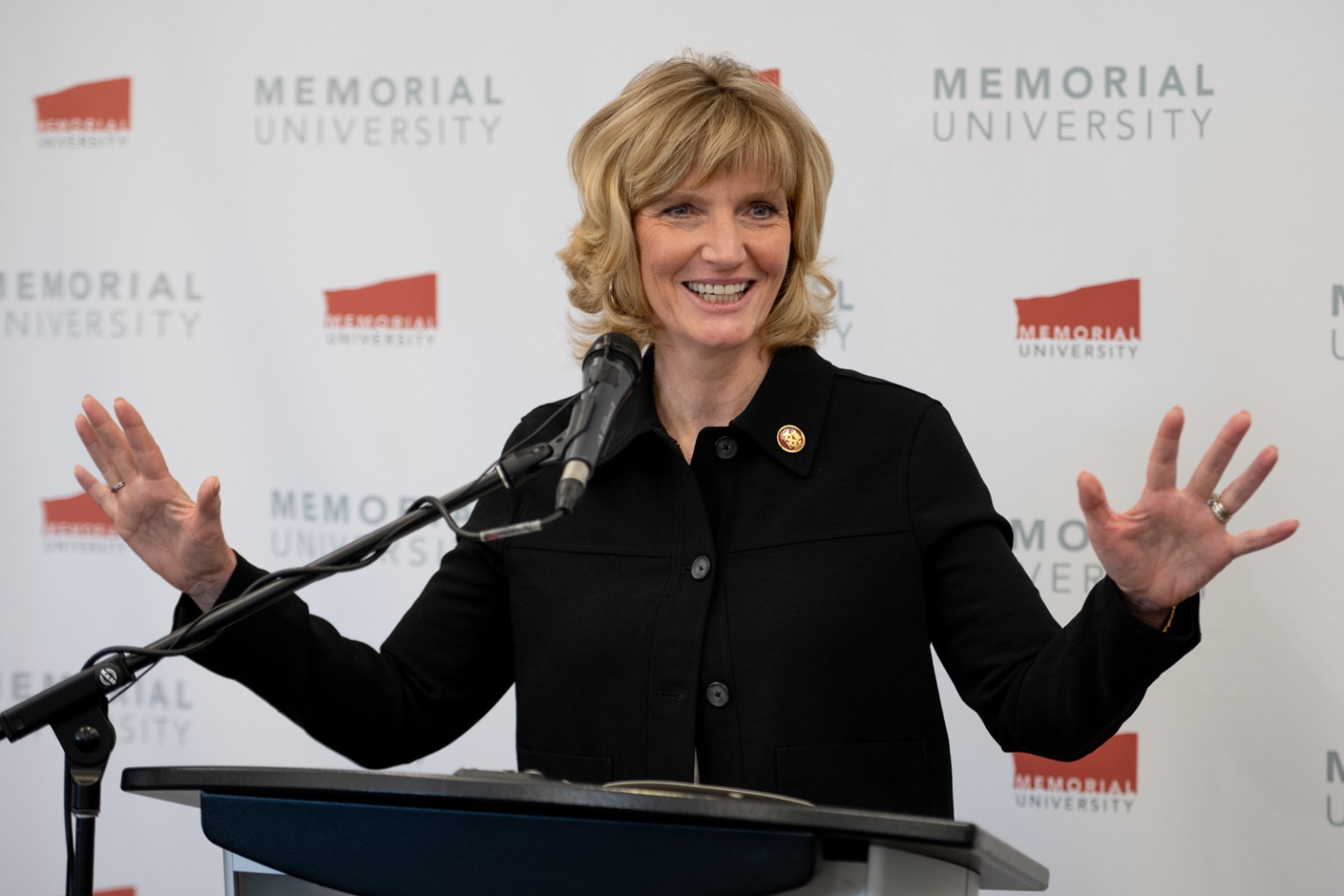
Memorial President Morrison responded that they can say with confidence that they have a better picture of Memorial’s circumstances broadly. Morrison said there has been an ongoing process to understand Memorial’s circumstances and contemplate the path forward.
She said, “The university… like every university I’m familiar with in the country, is navigating tremendous disruption and uncertainty at the moment.”
Morrison said that much of that is being driven by enrolment, and “the enrolment conundrum facing Canadian colleges and universities is a function primarily of three things.” She said the first is the demographic profile of the country, particularly in the burgeoning 18- to 24-year-old category.
Secondly, Morrison said it is a function of tremendously increased competition in the higher education space. Thirdly, the piece of the puzzle is dramatic and perhaps poorly communicated changes to immigration policy.
“Enrolment fundamentally drives everything about a university, its size, its scale, its financial circumstances,” said Morrison.
She said the disruption in that space is critically important to Memorial’s current state and future and that it impacts infrastructure.
Morrison said Memorial has a tremendous investment in capital and physical infrastructure, as well as digital infrastructure.
“But understanding our enrolment trajectory, I’m sure nobody is naive to our public statements that enrolment is down 2,000 students since 2021,” said Morrison.
“In the absence of intervention, which of course we are deeply vested in, but in the absence of intervention, the forecasting alone would suggest we’re going to be down another 12% by 2030,” added Morrison.
“And so everything we do is impacted by that reality. It’s why enrolment and enrolment recovery is amongst our top priorities. So I’m confident we have a much better handle on our current circumstances. I would not want to suggest, with due respect, that they’re any less complex.”
O’Leary said that understanding human resources is also one of education’s strongest assets. She added that the university recently eliminated 105 jobs, either through layoffs or attrition. She asked if that money was being planned to be used for deferred maintenance.
Morrison said that the contraction was tied to Memorial’s commitments on the operating budget for the 2026-2027 fiscal year.
Morrison said that Memorial has specific and dedicated funding for deferred maintenance that is supplemented by operational dollars, which she said was rightly observed as a gap a couple of years ago.
Morrison said, “But I want to be very clear that those contractions in FTE on the employee side, first off, were done with all intention to minimize the impact on colleagues, but also to meet our budget obligations in the context of the university contracting. Again, our revenue is tied to enrolment, so those would be on the operating side.”
Morrison then called on Memorial’s Associate Vice-President, Facilities, Rayna Luther.
Luther said deferred maintenance at Memorial is funded through two main streams: the campus renewal fee, which has been supplemented by the provincial government budget at $7.8 million, and a $70 million eight-year plan announced in a previous government budget.
“That equates to about $8.8 million over that eight-year period. So together, those combined, Memorial uses that funding to budget for and allocate projects to its deferred maintenance.”
O’Leary asked about demographics and said that enrolment is a challenge. She said Newfoundland and Labrador has an aging population and significant labour shortages in professions trained at Memorial. She asked Memorial if it has asked the government for increased funding to support the university’s upkeep so that job cuts are not necessarily the answer.
Morrison said it is important to distinguish between the contraction exercise and deferred maintenance. She said at the end of the day, it’s all a consequence of funding but that those are two equally challenging but distinct realities.
Morrison said, “We remain in very close conversation with the government about our current reality, about our current enrolment state, but also our forecasted challenges. We’re also in conversation with the government about labour market demand, particularly in the context of Newfoundland and Labrador’s planned major infrastructure projects.”
Morrison said that those conversations are ongoing and that Memorial needs “very different space to educate engineers or professionals in marine industries than we do to educate, for example, the incredible graduates from music or from folklore or from English. All of those learners. equally valued, and we expect to contribute equally economically, culturally, and socially to the province, but the space demands are very different.”
“So as the enrolment trajectory shifts, both in numbers and in areas of programmatic interest, we have some challenges on the facility side where foresight, accountability, process, and policy will be necessary,” said Morrison.
O’Leary asked if a climate action plan is an absolute in regard to infrastructure and its impacts.
“What do you have in store for a climate action plan so that we can ensure that we have this infrastructure protected going forward for the university?” O’Leary asked.
Morrison said that, in the context of infrastructure, Memorial has challenges around the weather elements. She said that, as is being experienced all across the country and around the globe, those challenges are becoming more apparent and more significant every day.
Morrison then asked Luther to provide further information.
Luther said Memorial is working with colleagues in the provincial government and Newfoundland Power regarding climate change and their responsibilities in adapting to these changes.
“The challenges we’re experiencing aren’t unique to Memorial, so we learn and share with our colleagues to build upon that,” Luther said.
Luther said she recently attended an asset management conference where they spoke about the challenges of climate change and how it is impacting the way they do business.
She said Memorial’s consultants stay very up to date on code changes and things that Memorial needs to design for.
“It’s not simply just replacing like for like anymore when something fails. We have to incorporate the resilience and changes needed going forward as we plan and repair to make sure that we can sustain the frequent and intense storms that we’ve been seeing,” Luther said.
O’Leary asked if Memorial’s leasing component is part of its divestment plans and if Memorial is going to start reducing its leasing footprint in the community. O’Leary said Memorial is shrinking into a more centralized campus component. She asked if that is the direction that Memorial is going to continue to go. She asked if Memorial is going to divest from those leased properties and try to get them into the infrastructure at the university.
Morrison responded, “So, certainly a contraction in some spaces would be helpful to cost management, right?”
She said that one of the challenges in that space is specialized need and that a not insignificant number of those leases provide housing to medical students who are in the community supporting essential, fundamental care. She said Memorial is not going to pull back on those leases and that she does not think anybody is suggesting that Memorial should do so.
She said that, in other instances, leases are supporting highly specialized work that is fundamental to Memorial’s commitments, whether those are on the teaching side, the research side, or on the service side.
“So, certainly there has been a very critical assessment of our leases to date and a commitment to trying to lessen our reliance on those spaces. But some of that, it’s not going to go away in service to our… commitments to the province, to our learners and to our researchers,” said Morrison.
Memorial’s Director of Operations and Maintenance Scott Hill pointed out that some of Memorial’s leases are nursing facilities in Gander and Grand Falls, as well as the Labrador Campus.
O’Leary said she wants full transparency on those leasing agreements and no conflicts of interest.
Morrison responded, “The commitment to ensuring accountability includes… across the board, full review, full oversight and navigation, mitigation, identification and then mitigation of any conflicts of interest.”
O’Leary said the City of St. John’s has the highest concentration of cultural community and arts community, and the only intersection at this stage that the university has in the capital city is through programs in humanities and social sciences.
She said that understanding that and relating it to infrastructure, the humanities and social sciences and all of those departments that are now housed in the science building: “Where are they going to go? Are they going to be dispersed throughout the campus? Are they going to be going into the new Core Sciences Building? What is the future for that?”
Morrison reiterated Memorial’s commitment to delivering on what the province needs culturally. She said they talk a lot about economic and social aspects but that it is important to reiterate Memorial’s commitment to supporting and promoting growth and development in the cultural space.
Morrison said she would be willing to discuss examples offline and called on Rayna to provide information on the programs and colleagues that are in the Science Building and the plan to relocate them.
Luther said they have a fully developed plan for that relocation. The Department of Geography will be moved to the Biotechnology Building. That would need to be renovated to house the department, and a design is complete and ready to go to tender for that move.
The Humanities and Social Sciences would move to a renovated Chemistry-Physics Building. That one is in the concept design stage pending funding, so they would move that design further if they were to receive funding.
The Psychology Department, which is still in the Science Building, would move to the Core Science Building in a currently shelved space in that facility.
Matt Barter is a graduate of the Humanities and Social Sciences Faculty at Memorial University of Newfoundland, holding a degree in Political Science with a minor in Sociology. He enjoys reading thought-provoking articles, taking walks in nature, and volunteering in the community.


Leave a Reply