
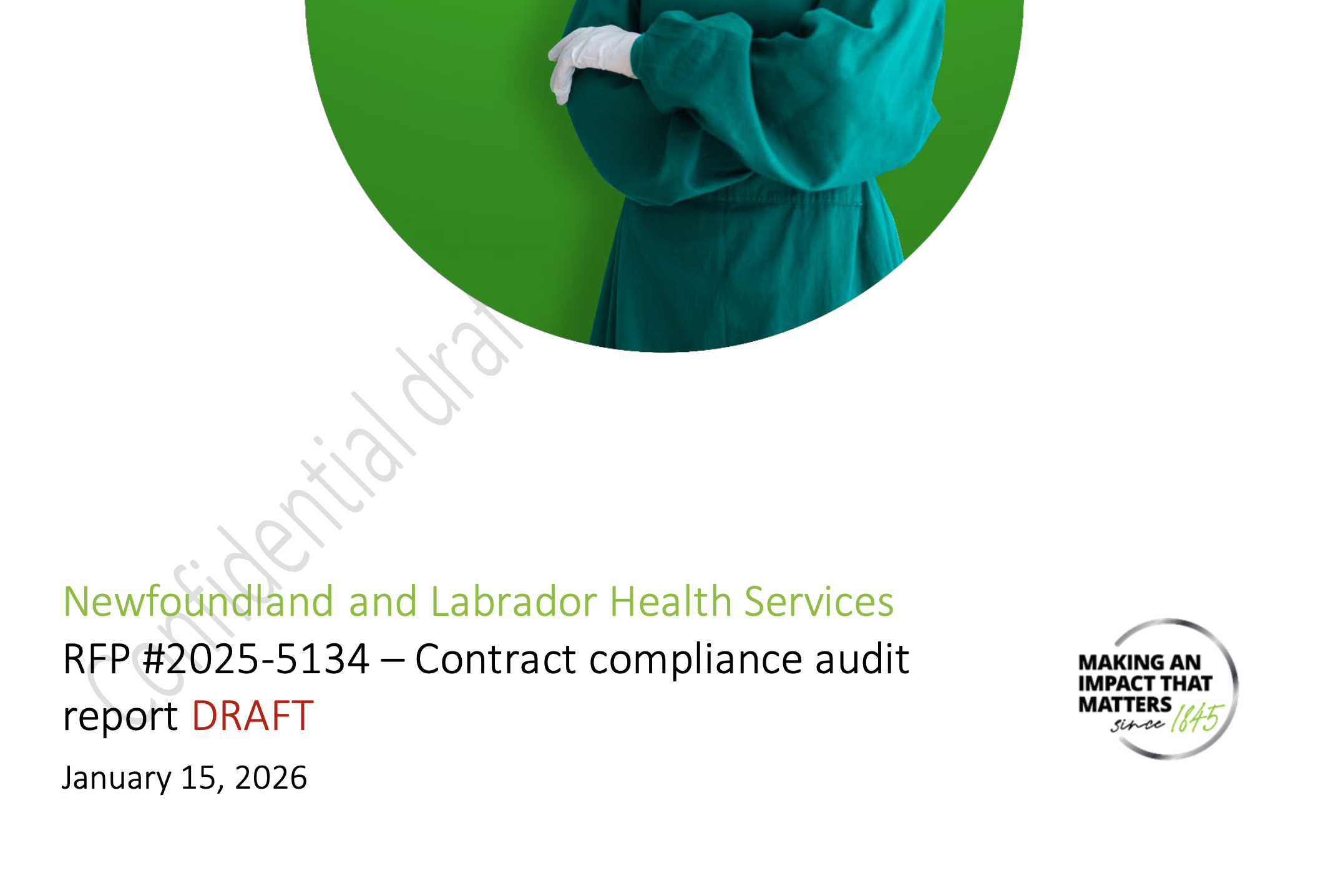
A draft forensic accounting report prepared for Newfoundland and Labrador Health Services identifies billing discrepancies and contract compliance concerns in a review of $74.5 million in payments to Canadian Health Labs, but extensive redactions conceal its central findings and any potential recoveries.
The Deloitte report, dated January 15, 2026, examined 418 paid invoices across 2022 to 2025 for agency nursing services under the Central, Western, Eastern, and Airway contracts.
The review followed a recommendation from the province’s Auditor General to conduct a comprehensive examination of amounts paid to Canadian Health Labs and recover public funds paid in error.
Visible passages describe differences between billed nursing hours and health authority records, an inflation adjustment above Deloitte’s calculation of the contractual increase, and missing ordering documents.
However, the released version does not reveal the full extent of Deloitte’s findings. Sections addressing non-compliance, possible non-compliance, and indicators of heightened fraud risk are heavily redacted, along with much of the conclusion and supporting tables.
Deloitte states that it offers no opinion on whether the information is sufficient to establish civil or criminal wrongdoing.
The document is marked as a draft. At the time it was written, Canadian Health Labs had not yet commented on Deloitte’s preliminary findings or the completeness of the documentation supplied to the firm.
Most payments went to Central and Western
Deloitte’s payment summary shows approximately $41.5 million paid under the Central contract and $31.2 million under the Western contract, including harmonized sales tax.
Payments under the Eastern and Airway contracts totalled approximately $1.18 million and $593,000, respectively. Nearly $48.7 million of the overall payments occurred in 2023.
A separate breakdown of invoice charges lists $58.8 million in professional fees before HST, approximately $2.55 million in meal allowances, $1.78 million in transportation expenses and $1.61 million in accommodation costs.
These figures describe spending reviewed by Deloitte and do not establish improper billing.
Billed hours and inflation adjustment raised concerns
Under the Central contract, Deloitte examined 194,089 billed nursing hours and compared invoice details with electronic and manual time records.
The firm identified discrepancies between invoiced hours and corresponding health authority records. It also calculated the financial impact of Canadian Health Labs’ application of a minimum shift length for invoicing. The detailed results and dollar amounts are redacted.
Some manual time reports were unavailable, and Deloitte said the quality and completeness of paper schedules varied.
In the Western contract section, an unredacted paragraph compares a 3.40 per cent inflation increase applied by Canadian Health Labs with a contractual adjustment Deloitte calculated at 3.27 per cent.
Deloitte describes the difference as non-compliance with pricing terms. It says possible explanations include an incorrect contract interpretation, a calculation error or other administrative issues.
The paragraph refers to the “Central Contract” despite appearing in the Western contract section, an apparent drafting inconsistency.
In its Airway nurses analysis, Deloitte also identified discrepancies but could not determine their cause.
“We did not identify a consistent pattern of discrepancies, and we also observed instances of underbilling,” the report states.
Deloitte said data limitations, operational inconsistencies or errors in time reporting and reconciliation could explain those differences. Additional supporting information was needed to determine their cause.
Ordering documents were unavailable
Deloitte requested ordering documents referenced in the Central contract, but NLHS told the firm that no such documents existed.
The report also reproduces Western contract provisions requiring mutually signed ordering documents to establish the number and types of teams deployed, nursing specialties and deployment locations. The findings beneath that discussion are redacted.
Review covered every invoice within its scope
Deloitte says it examined every invoice within the review’s scope, together with available supporting records, rather than relying on a sample.
Its work included comparing invoices with health authority time reports, timesheets, expense reconciliations and other documentation.
For parts of the review, investigators also used flight and ferry information to assess whether nurses were physically present in Newfoundland and Labrador on dates for which services or expenses were billed.
The firm nevertheless identified limits to the records available.
Deloitte could not confirm whether NLHS had passed on all supporting documents originally supplied by Canadian Health Labs. Where documents were missing, Deloitte could not determine whether the company failed to provide them or whether NLHS was unable to locate or supply them.
Deloitte also could not obtain the original versions of certain hours reconciliations prepared by Canadian Health Labs. NLHS modified the available versions before paying the invoices to reorganize information and add reconciliation details.
The firm relied on health authority time reports without independently verifying their accuracy or completeness.
Payment reconciliation and vehicle charges questioned
One unredacted section identifies an $8,787 difference between the payment total and Deloitte’s categorized invoice total.
The report attributes that difference to several reconciling items, including discrepancies between invoice expense lines and supporting expense reconciliations, payment of an invoice that had been voided, and a credit memo of approximately $16,449 that was recorded but not applied against an invoice.
The $8,787 difference is not presented as a comprehensive total of overpayments.
Another visible passage says Deloitte identified no contract between NLHS and Canadian Health Labs specifically for the provision of electric vehicles during its contract review or discussions with health authority employees.
Other passages reproduce nursing contract provisions allowing certain vehicle rentals, subject to conditions.
Deloitte also refers to “questionable charges” on Canadian Health Labs invoices in the electric vehicle section. The details of those charges and the related financial findings are redacted.
Company response was still outstanding
Deloitte said it had prepared questions and requests for information for Canadian Health Labs and was awaiting further direction from NLHS on the review’s next phase.
The draft therefore captures preliminary findings before the company had provided comments through that process.
The review did not assess NLHS’s procurement processes or the design and implementation of its controls over vendor payments.
The released document reveals specific billing and documentation concerns. With the principal findings concealed and the company’s response outstanding when the draft was prepared, it does not provide a complete public accounting of how much money, if any, should be recovered.
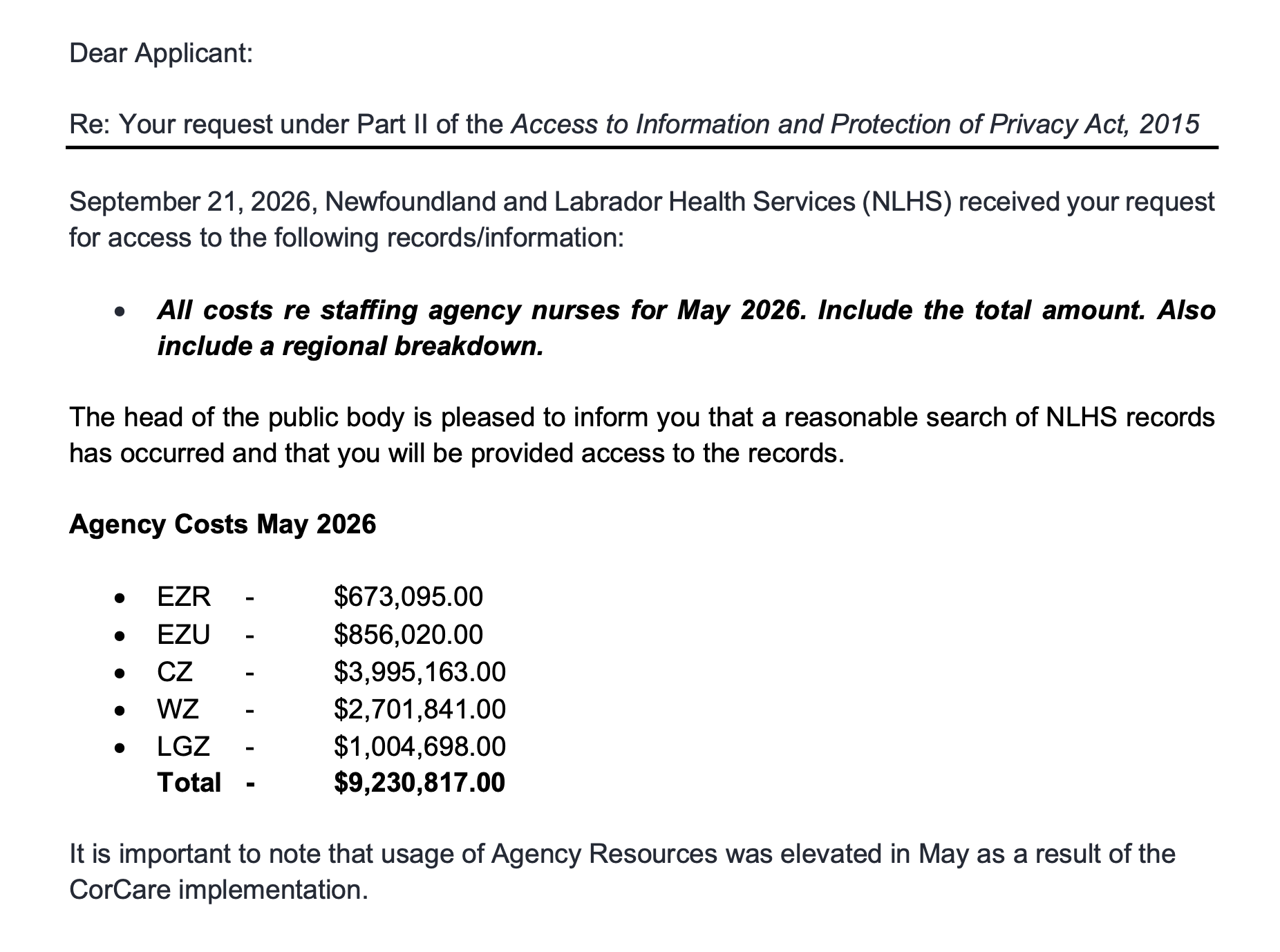
View the ATIPP file below:
Matt Barter is a graduate of the Humanities and Social Sciences Faculty at Memorial University of Newfoundland, holding a degree in Political Science with a minor in Sociology. He enjoys reading thought-provoking articles, taking walks in nature, and volunteering in the community.

Leave a Reply