
On October 27, 2023, VOCM Open Line host Paddy Daly spoke with Memorial University president Neil Bose. See the transcript below:
Paddy Daly: Welcome back to the program. Joining us on line #1 is the President and Vice-Chancellor Pro Tempore at Memorial University of Newfoundland, that’s Dr. Neil Bose. Dr. Bose, you’re on the air.
Neil Bose: Good morning, Paddy.
PD: Welcome to the show.
NB: Thank you.
PD: You know, before we get into some of the details of the findings of the Auditor General’s report and some of the things that had been done at Memorial University to change its ways and work that had yet to be done, I’m curious you know obviously with what they call a culture of overspending, inefficiencies, lack of accountability. In-house, there was an awareness of this, maybe not to the extent that the Auditor General’s report reflects, but when the government withheld $68 million, which, of course, saw the doubling of tuition, was there any effort in-house to not have it reflected directly on tuition but to try to carve some of their overspending that was obviously happening at Memorial University? So, was anything entertained beyond just immediately going to doubling tuition?
NB: Thank you for the question. Well, we accept the findings of the Auditor General’s report, and I’d like to say that over the last ten years, $55 million has been taken out of the university’s budget, reduced in the university’s operating budget, and those progressive cuts have led to efficiencies right across the institution. The report now gives a picture at the present time, and we’re committed to bringing in further changes to streamline even more so we actually welcome the findings because it gives us further information, further advice and an impetus to proceed further.
PD: So, when the student union and the faculty association both say none of this is surprising because they knew there was this type of culture of overspending. So again, was there any exercise or attention given to anything but doubling tuition when government withheld that additional $68 million over five years?
NB: $68 million is a very large part of the university’s budget, so you can see that if administrative costs were cut by $100 per student, that would be $1.9 million, so you can see there’s an enormous amount in that $68 million. It’s not possible to just trim a certain amount off the administrative costs and then not address the issue of the $68 million tuition offset grant cut.
PD: If you took $100 off the administrative salaries per student at $2,369 to bring it down to $2,269, it would still be way ahead of the next most expensive university at $1,994. So, you’re saying it’s an impossibility? Or was there any attention given to that potential to not see a doubling of tuition?
NB: So, we will focus on change, and we will be looking at overall administrative costs, and we will be bringing in changes to address these going forward, as the university has been doing over the last ten years, as I explained, with $55 million taken out of the budget in ten years.
PD: I’m curious on your thoughts on some of the redactions that were part of the report. Lawyers back in August from Genesis Centre and C-Core sent cease and desist to Denise Hanrahan’s office, so I know there are, you know, part of the university, your thoughts on why were not able to see under the hood there with whether it be compensation and/or bonuses paid or whatever we’re not allowed to see at this moment in time. Your thoughts as the leader of the university?
NB: Yes, so these are separately incorporated entities. They act at arms-length from the university. The reason, of course, I have no idea exactly why the government redacted certain information from the report. That’s government legal advice that led to that, but I do know that from the advice, the legal advice the university had, and the SIEs had, the separately incorporated entities had, they were given advice that they were not part of the university, that they don’t have to provide the compensation disclosures that a public body like Memorial does have to provide. The AG takes a different view on that, and this comes down to a discussion between legal, a legal discussion which, of course, the outcome of which we will follow.
PD: Regarding compensation, I would like to see those numbers because, as they might be so-called stand-alone, they are simply arms-length of the university and play a distinct role in the operations, academically as an incubator and research both a C-Core and Genesis. Let’s talk about compensation. So, the report says that there is about a $143,000 difference between the salary of a campus Vice-President and what people would call equivalent in operations in government, an assistant deputy minister. So, what has been done to address that? Are we seeing salary rollbacks, or what are you going to do in the future because there’s a long way between an assistant deputy minister, their role, and we’ll get into job descriptions in a moment. What’s going to be done now about compensation afforded to these executive positions?
NB: Well, the first thing I would say is that the roles at the university are not equivalent to the government, and so our compensation comparators are equivalent universities, and you see actually in the information we provided on our website the levels of presidential of VP salaries at Memorial are in comparison with Dalhousie, UNB, and University of Victoria which are very comparable universities to Memorial.
PD: So that said, what’s behind this discrepancy between administrative salaries per student at Memorial University, then it’s next closest, and the national average of $893? Why the big difference if we have a comparative scale for compensation?
NB: Well, those two are different things, but we do know why there’s some differences. The first is that the Stats Can information, which the AG was working from, includes the total number of students at Memorial, and so to get the number of admin costs per student, you divide the admin cost by the student load. We know that there’s a certain level of students that are not counted in that Stat Can information because none of the diploma students at Marine Institute, which is actually the majority of students at Marine Institute but not counted in our student total, so that sets us on the high side. The other thing that sets us on the high side is the fact that we have multiple campuses, which historically have been set up with their own administrative services, and so that also adds to the administrative costs of the university per student, and these are the sorts of things we have to look at really, really hard going forward. How can we streamline those operations and bring our admin per student costs down even further?
PD: When we talk about accountability and comparative scale for compensation for different positions at the administrative level, 97 percent of the VPs, or pardon me, 36 positions were sampled, 97 percent did not have a position description, no job description, no position descriptions for the seven VPs and none for 28 of the 29 management positions. Would you agree that it’s hard to know whether or not we have an administrative bloat, whether or not we have accountability given the fact that we don’t really know what the core responsibilities of leadership and executive positions? Will they be established so we can better have a threshold for monitoring and check boxes for success and/or efficiencies?
NB: So, the university does actually have descriptions of each of the positions that we have. Each of the administrative in our university know absolutely very clearly what their job is. Many of these positions are relatively new. They’ve been hired recently and there are job advertisements and documentation and role descriptions, all of which pertain to these positions.
PD: If that’s the case, why was the Department of Human Resources unable to provide that information to the Auditor General?
NB: All of this information has been provided to the Auditor General.
PD: But of course, a quote coming directly from her office said, “As a result, we could not determine the exact number of staff performing specific functions within the university.” So, there’s a contradiction between you saying they have it versus the Auditor General saying they don’t have it. Can you help us understand why that would be?
NB: The university cooperated fully with the Auditor General, and it will do so going forward. We actually welcomed them into our operation, and we provided them with total information. In some cases, we have role descriptions that might not have position description written at the top. All this information has been provided to them, and I can assure you that the university does know exactly what each of its positions their job description is.
PD: When we talk about compensation policies, nonexistent or outdated, as quoted by the Auditor General, it’s some of the smaller price tag items that really draw the eye or the curiosity of the taxpaying public here. Things like $50,000 special allowances for Deans and Directors to host events attended solely by university staff. So, there’s also concerns about travel. What’s been put in place to see pre-approval of these types of expenditures before they happen because those are the little ones that really draw people’s attention. $2,700 for an office desk and a chair and expensive chocolates. What’s going to be put in place in so far as guardrails so that these things aren’t part and parcel of the culture at Memorial University in the future?
NB: So, some of the things pertaining to former employees, which I cannot really comment on. What I can comment on is quite a number of changes have been brought in during the last six months, and we have focused in on ensuring that deviation from policy is minimized. So, a good example you raised travel. So, over the years, we have had an increasing number of deviations on travel policy because the per deim rates were set 25 years ago, and we have recently changed those rates to agreement at a Board of Regents to reduce the number of deviations that occur in the administrative approach that goes with that. We also changed the approach to travel requests, which you also raised with the senior executive. All employees actually have to fill in a travel request sign-up system form before they travel, and, in this case, the senior exec level, we have tightened up how that is agreed to, and this is a change that’s been brought in over the last six months so now the VPs I sign off on travel requests for the VPs and the Board signs off travel for me as president.
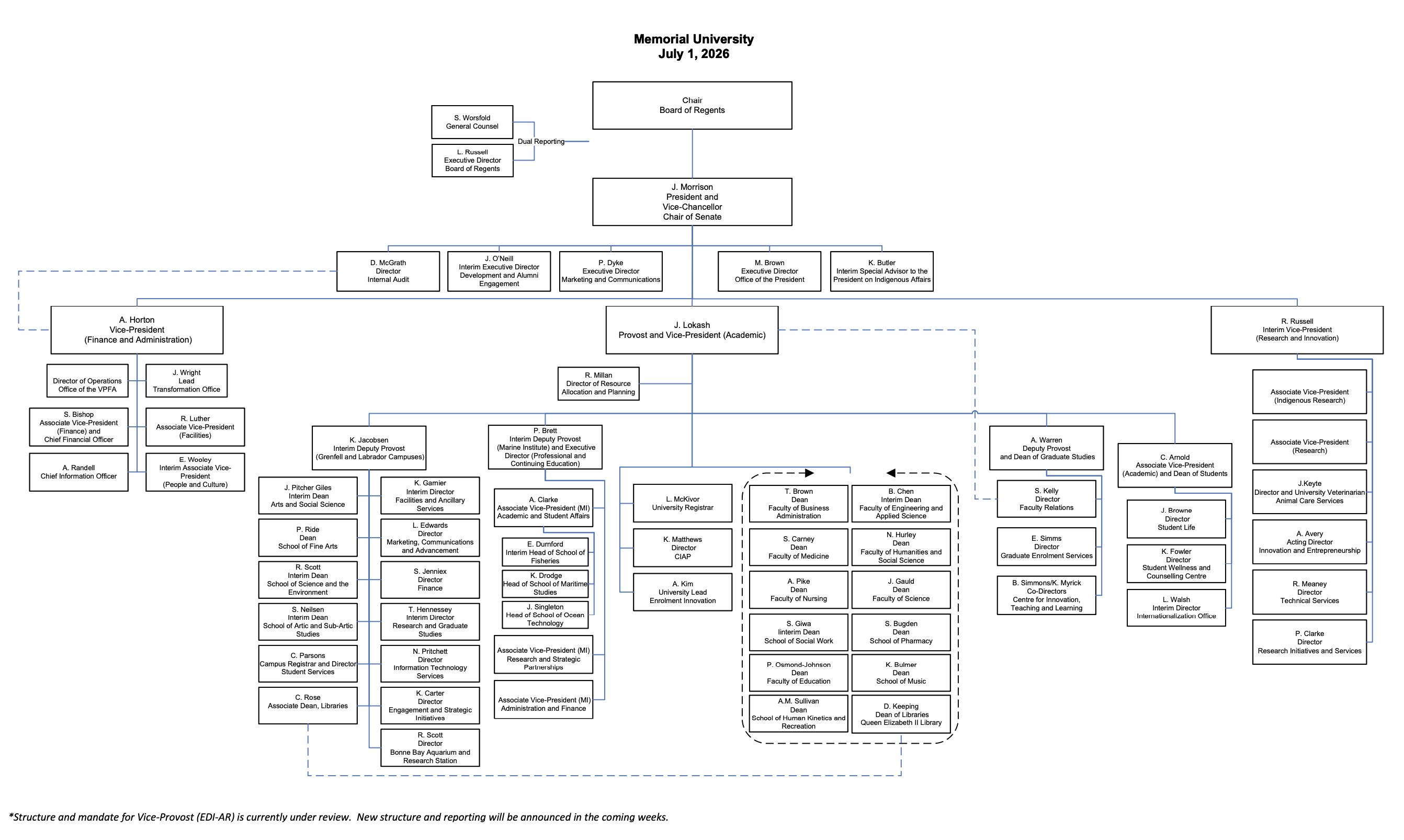
PD: Where does the responsibility ultimately lie? Is it Mr. Barnes and his group? Is it with the Senate? Is it in your office? Because when we are going to be looking for a further examination of policies being currently implemented and work yet to be done just to get a measure of where we are, where does the responsibility lie? Who should I have on next say this time next year to see where we are? Yourself? Mr. Barnes? Someone from the Senate? Where should we go?
NB: Well, that actually depends on which part of the university, what part you are focused. If you are talking about the operations like today, it would be me, the president, and the Board of Regents decides overall, has oversight of the university in a governance sense, the operational sense, and of course, it’s the executive, and hence, the president is responsible for the operational aspects. If it’s the academic part of the university, that’s where all the programming is decided at Senate, and it’s again actually the president chairs Senate, but there are a lot of academic voices that are often useful to engage as well.
PD: I suppose I should have been a bit more precise because I was thinking operations more than anything else. Very quickly, before we let you go, this is outside the scope of the AG report, but every year, we have an issue regarding international students and access to housing. The last couple of years have been further complicated and exacerbated. With an active recruitment program at Memorial University to bring international students in, do you think it should be more the responsibility of the university to provide housing? Because the stresses on the market here in the city, vacancy rate at about 3 percent, and I know there’s a lot of work to be done infrastructure-wise at Memorial, but do you think the university should own much more, if not all, the responsibility, for housing the students they recruited?
NB: So, in fact, the university has a responsibility, as you say, for ensuring that housing or that students coming in are able to solve their housing problems, but I would also say that the university shouldn’t provide all of that accommodation. We do have a housing issue here this fall with the start of the academic year. It’s nowhere near as severe as it is in other places, and there’s housing issues right across Canada and also Australia and other parts of the world. Here in Newfoundland, the situation we’re now at a point where we still do have incoming families in temporary accommodation. The individual students, we actually have vacancies now both at undergraduate and graduate levels, so there isn’t a shortage there, and I will say that we welcome this private development that is planned to be built over the next year to the west of the campus here in St. John’s because that will also provide accommodation and it will alleviate the housing market for students coming in which is obviously very good. The international students are hugely valuable to Newfoundland and Labrador, bringing in diversity, adding to start-up companies and so on. More than half of the incubated companies at the Genesis, which is one of our separately incorporated entities, more than half of those start-ups are actually international entrepreneurs.
PD: Very last one, and far be it for me to put this policy forward, but you know, with the Premier commented on this report, would you accept as president of the university some caveats associated with this report with government transfer dollars to make sure that some of these pledges to do better, to tighten up, for better oversight, and monitoring of all the issues this morning? For a checklist, have you met this pledge? Have you implemented this policy? Would you accept if the government said unless you do it, it’ll be further jeopardy to government transfer of money?
NB: We work closely with government on this and have met several times this week and regularly meet with them, so we are constantly talking with them and are accountable to government. We take that accountability extremely seriously and because of the public funds that are entrusted to the university.
PD: I appreciate your time, Dr. Bose. We’ll reach out again in the near future to see where we are at MUN.
NB: Thank you very much.
Matt Barter is a fourth-year student in the Humanities and Social Sciences Faculty at Memorial University of Newfoundland, majoring in Political Science with a minor in Sociology. He enjoys reading thought-provoking articles, walks in nature, and volunteering in the community.

Leave a Reply